
In our previous article, we explored how children can care for the world around them through the Kindiedays Environment theme. Now our journey through experiential lesson plans continues with something children notice every day.
How did you come to preschool today? What can a bus carry? Could we make a bicycle using our bodies? How could a journey help care for our planet?
These questions connect children's everyday experiences with opportunities for language, creative expression, cooperation and movement. They also help teachers introduce environmental awareness through situations children can understand.
For preschool owners and academic coordinators, the theme offers a practical example of how familiar interests can support purposeful learning across the week.
One theme with many opportunities for learning
Children arrive at preschool with their own travel experiences. Some walk with a family member. Others come by car, school van, bus or auto-rickshaw. They may have watched a train, waved at an airplane or enjoyed riding a bicycle.
Teachers can begin with these experiences and invite children to describe, imagine and investigate. A conversation about a familiar vehicle can lead to a story, an artwork or a shared movement game.
Children might explore questions such as:
· How do different vehicles move?
· What do we notice along our journey?
· How can a group move together like a bus?
· Why do we need clean roads and shared spaces?
· Which ways of travelling can help us care for the environment?
The teacher introduces a clear learning purpose while giving children room to contribute their own ideas.
Why explore Transportation in preschool
A transportation theme can bring several learning areas together. Describing a toy develops language. Creating a journey collage encourages expression and decision-making. Becoming a pretend vehicle with friends calls for coordination and cooperation.
The free Kindiedays Level 2 Transportation sample introduces a week called Means of Transportation. Its weekly overview outlines five activities across the Finnish early childhood education learning areas.
The examples below introduce the five activities in the sample. Suggested questions and observation ideas show how teachers can make the learning visible.
Download the free Transportation Level 2 Sample and explore the ideas with your teaching team.
Example 1: Let’s Describe It
What could be hiding inside the mystery bag?
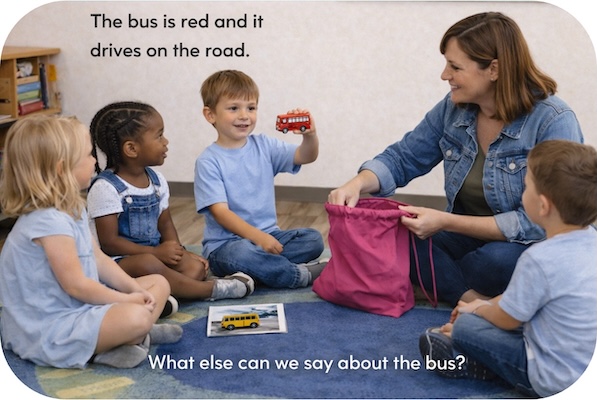
In this activity from the weekly overview, children take turns choosing a transportation toy and describing it. They talk about its appearance, how it moves, and what people use it for.
Teachers can build on a child's contribution with a simple question: “You noticed the wheels. What else can you see?” Children who need support can point, make a vehicle sound, or respond to a choice of words.
What are children learning?
Children practise describing familiar objects, forming sentences and listening to others. The shared experience gives new vocabulary a clear meaning.
A teacher might notice whether a child names a vehicle, adds a descriptive word or explains its purpose. These observations help the teacher decide what language support to offer next.
Example 2: Let’s Build a Bus
What do we need to make a school bus for our classroom?
The teacher introduces pictures of buses and invites children to notice the wheels, windows, doors, and steering wheel. The group talks about how buses help people travel together and what colour they would like their own bus to be.
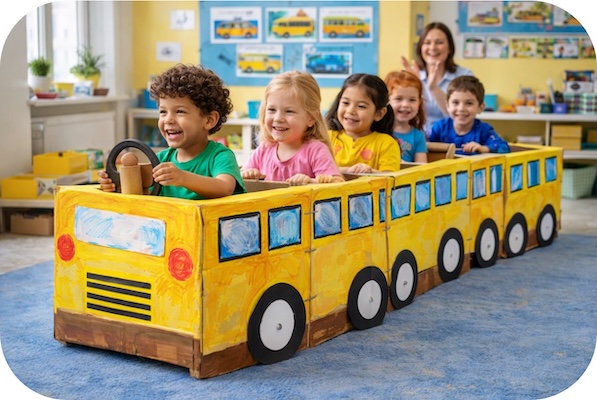
Each child paints a cardboard box. Once the boxes are dry, the teacher helps connect them to create a large bus. Children decorate paper-plate wheels and help make a steering wheel from cardboard and a paper roll.
When the bus is ready, it becomes a setting for imaginative play. Children can take turns as drivers and passengers and sing “The Wheels on the Bus” together.
What are children learning?
Children experiment with materials, practise fine motor skills, and contribute to a shared project. As they work, they can solve practical problems: Where should the wheels go? How can the boxes become one bus?
The lesson also introduces the idea that familiar materials can be reused. Teachers can observe how children share ideas, make choices, and work together. The sample suggests approximately 60 minutes, with time for the painted boxes to dry.
Example 3: Water, Land, Air
Does a boat travel on land, water or through the air? What about an airplane?
Children gather around pictures of land, water and air. They choose transportation pictures and place them in the category they think fits. The teacher supports their thinking with simple questions and invites children to explain their choices.
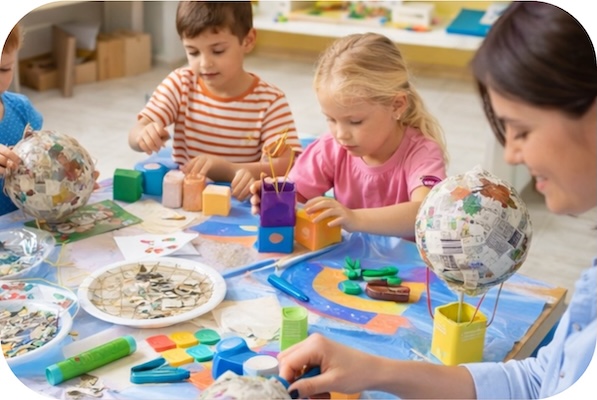
The exploration continues with a collaborative hot-air balloon craft. Children work in groups: one group paints milk cartons to make baskets while the other glues pieces of newspaper onto balloons. Then they swap so everyone can try both tasks. Once the newspaper balloons are dry, the teacher helps finish the models.
What are children learning?
Children compare and classify different forms of transport while developing the language to explain their ideas. The craft gives them opportunities to explore and combine materials and take part in a shared creative process.
Teachers can observe how children make a sorting choice, respond to a question or participate in the group task. The teacher handles the glue gun when assembling the balloons. The sample suggests approximately 60 minutes, with additional drying time as needed.
Example 4: Parking Challenge
Can you find the parking space that matches your car?
The teacher creates a pretend parking area with spaces numbered from 0 to 10. Toy cars are labelled with matching numbers and placed around the play area.
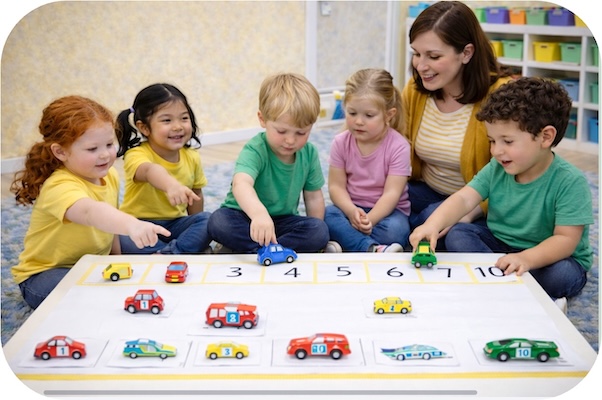
Children choose a car, say its number aloud, and drive it to the corresponding parking space. The teacher supports the children as they compare numbers, count, and help one another find a match.
What are children learning?
Children practise recognising, naming and matching numbers through play. They also use problem-solving skills as they decide where each car belongs.
The teacher can observe which numbers a child recognises independently and when a prompt or a friend's help makes a difference. The teacher can adapt the activity by starting with a smaller set of numbers. The sample suggests approximately 45 minutes.
Example 5: Practice Ride
The bus is ready. Are all the passengers sitting safely?
The teacher arranges child-sized chairs like bus seats and attaches ribbons to represent seatbelts. Children move around the room to “The Wheels on the Bus”. When the music stops, they take their seats and practise sitting with their feet on the floor, fastening their pretend seatbelts and using quiet voices.
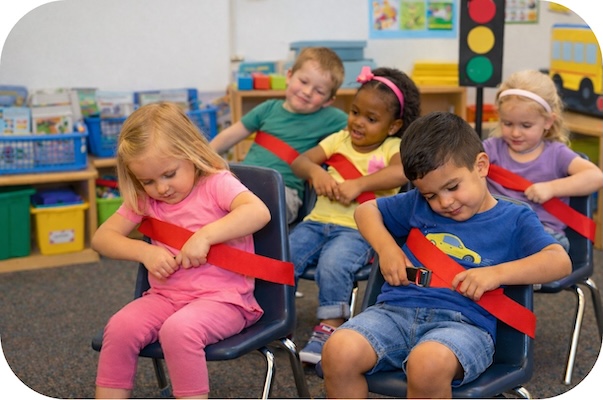
During the imaginary ride, the teacher describes a bumpy road, a turn, or a stop. Children respond with small movements while staying seated. The teacher pauses to ask the group what safe passengers do.
What are children learning?
Through movement, music and role play, children practise recognising safety rules and following instructions. They also develop body control and awareness of others in a shared space.
The teacher can observe how children respond to the different prompts and recall the routines during the game. The sample suggests approximately 45 minutes.
The teacher makes the learning purposeful
Across these activities, clear objectives help teachers recognise learning during play. A child's explanation, a thoughtful material choice or a moment of cooperation can guide the next interaction.
The collage lesson, for example, connects creative expression with environmental education and the transversal competency Thinking and Learning. Its structure helps teachers prepare an engaging experience and know what to look for as children participate.
Teachers can document a child's words alongside a photograph of the collage. Sharing the explanation with parents helps them understand the thinking behind the artwork and gives them something meaningful to discuss with their child.
For owners and academic coordinators, these observations provide a practical basis for supporting teachers and discussing the quality of everyday learning.
From Transportation to a full year of experiential learning
Transportation is one of eight Kindiedays themes:
All About Me, Seasons & Weather, Animals, Community Helpers, Under the Sea, Environment, Around the World and Transportation.
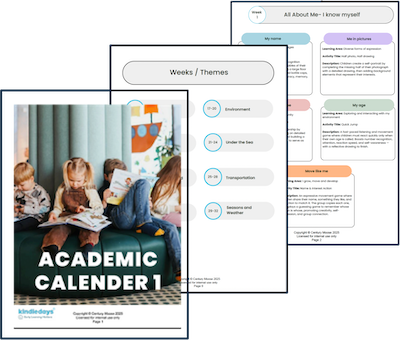
The Academic Calendar connects the themes into a structured learning journey. Teachers gain a starting point for planning experiences across different areas of development, while adapting activities to their children and local setting.
Within the Kindiedays Learning System, teacher development, lesson plans, and digital tools support the same pedagogical process. Training builds understanding. Lesson plans connect activities with learning objectives. Digital tools help teachers record observations, document progress, share learning with parents, and use evidence for formative assessment.
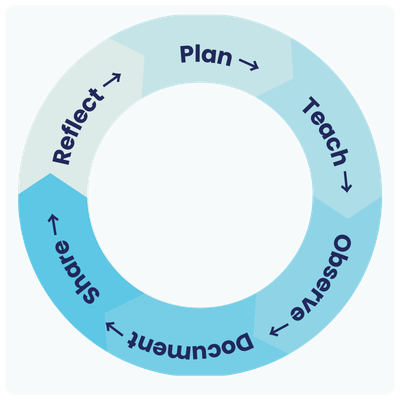
This connected approach supports teachers in planning their work and deciding how to help each child move forward.
Try Transportation with your teaching team
Download the free Transportation Level 2 Sample to explore the weekly overview, try My Journey That Helps the Planet, and use the supporting transportation pictures with your children.
Start with a familiar journey. Listen to the children's ideas. Notice what their choices and explanations reveal about their learning.
Explore the Kindiedays Learning System to see how teacher development, lesson plans, and digital tools can support this work throughout your preschool. One more theme, Around the World, is coming in a future blog.
Happy learning!
Team Kindiedays