
In our previous article, we explored how children can imagine, investigate and create through the Kindiedays Under the Sea theme.
Now our journey through experiential lesson plans continues with a world children can explore every day:
Environment 🌱🌳🌼
What might a stone inspire us to say? How can we help a plant grow? Can we find a leaf while hopping like a rabbit? Where might we discover numbers in a garden?
These questions invite children to observe, talk, create, move and care for their surroundings. They also give teachers opportunities to support language, creative expression, social development, mathematical thinking and physical development within one connected theme.
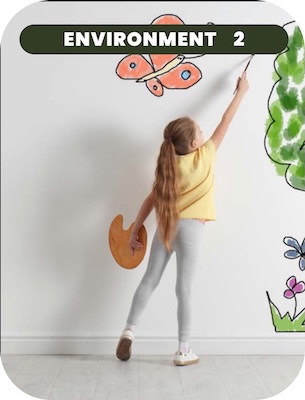
For a preschool owner or academic coordinator, this brings an important benefit: a familiar topic becomes a practical framework for purposeful learning throughout the week.
One theme with many opportunities for learning
Children’s environment begins close to home: a plant near the classroom window, a tree in the playground, a stone beside a path or flowers outside the preschool gate.
These familiar surroundings offer a starting point for exploration. Children can notice details, ask questions and discover how their actions affect living things.
Teachers can investigate questions such as:
- What can we see, hear and feel around us?
- How are these leaves or stones different?
- What does a plant need?
- How can we care for the places we share?
- What stories could we imagine about animals, trees and rivers?
- How can we use nature as inspiration for art, music and movement?
A preschool does not need a large garden to begin. Teachers can adapt experiences to a small outdoor area, a few planted pots, or suitable natural materials brought into the classroom.
The learning grows through what children do with these opportunities—and how the teacher supports their thinking.
Why explore Environment in preschool?
The Environment theme connects discovery with everyday responsibility.
Children can create a story about a tree, care for a real plant, paint flowers for a counting game and explore natural objects through movement. Each experience opens a different route into learning.
The free Kindiedays Level 2 sample, Environment—Our Natural World, shows how these experiences can fit into a balanced week. It includes five lesson plans, a weekly overview and supporting printable resources.
The activities last approximately 30 minutes each, with 40 minutes suggested for Story Stones. Teachers can adapt the pace to their group.
The examples below come from that sample. They show both what children do and the learning teachers can support.
👉 Download the free Environment Level 2 lesson plan sample HERE!
Example 1: Story Stones—Collaborative Storytelling
What happens when a bird, a river and a tree meet in the same story?
The teacher prepares smooth, clean stones painted with simple nature pictures. These might include animals, plants, landscapes or natural events.
Children take turns choosing a stone from a bag. Each child looks at the picture and contributes a sentence to a shared story.
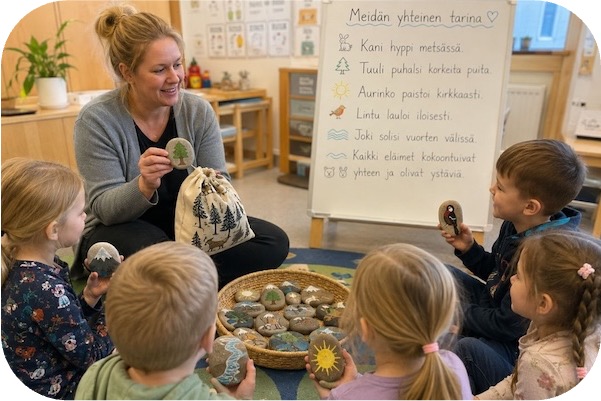
One child might begin with a rabbit hopping through a forest. Another adds wind blowing through the trees. The teacher helps children connect their ideas while leaving room for unexpected adventures.
As the story develops, the teacher records it on paper or a whiteboard. Reading it aloud at the end lets children hear what they have created together.
What are children learning?
Children practise speaking, explaining and narrating. They use nature-related vocabulary and listen to other children’s contributions.
They also experience how individual ideas can become a shared creation.
The teacher can observe how a child describes a picture, connects an idea to an earlier sentence or uses a new word. A quieter child may benefit from a gentle prompt or time to think before contributing.
The full Story Stones activity, including materials, objectives and instructions, is included in the free download.
Example 2: Song Bag—Action Songs
A bag of picture cards turns a familiar singing session into a game of anticipation.
Children gather in a circle as the teacher introduces the Song Bag. Each picture represents an action song.
The group sings a short introduction, then one child reaches into the bag and chooses a card. The child shows the picture and tries to identify the song before everyone sings it together with actions and gestures.
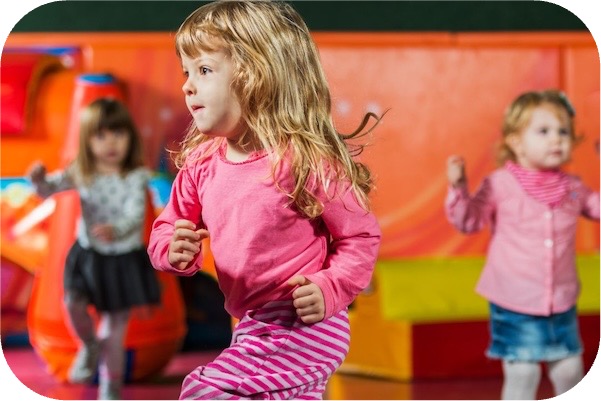
The card returns to the bag, and another child takes a turn.
Teachers can choose familiar songs that suit their children’s language and experiences. Songs about animals, weather or plants can strengthen the connection with the Environment theme.
What are children learning?
Children practise recalling songs, interpreting picture clues and connecting words with movement.
Singing together provides opportunities to experience rhythm, listen and participate in a group. Taking turns choosing a card gives children a meaningful role in the activity.
The teacher can notice which children recognise a song from its picture, remember words or join confidently through gestures even when they are still learning the language.
The free sample includes the Song Bag lesson and supporting picture cards.
Example 3: Caring for Nature—Guardians of the Garden
“Today we will become Guardians of the Garden.”
With this invitation, children take on a practical responsibility: caring for a small garden or natural area.
The teacher begins by asking what the garden needs. Children explore with magnifying glasses and notice details—a dry plant, insects nearby or something that needs attention.
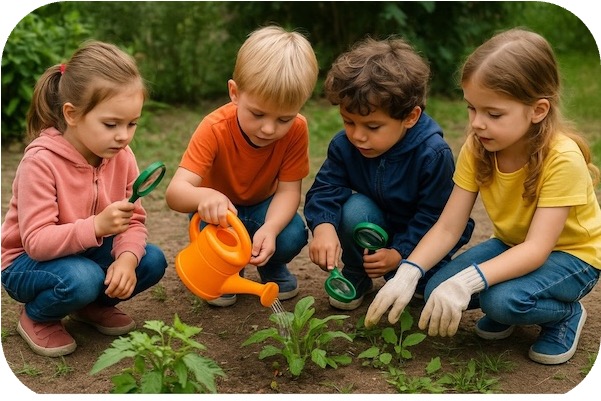
The group discusses what they have found. What might this plant need? Why does the ground feel dry? How can we help without disturbing living things?
Children then work in small teams, taking suitable responsibilities such as watering plants or caring for a shared outdoor spot.
Afterwards, they discuss what they did and draw something they helped care for.
What are children learning?
Children practise observation, cooperation and reasoning about cause and effect.
Caring for a real place gives them an opportunity to connect respectful behaviour with practical action. They can begin to explain why plants need care and how people’s choices matter.
Teachers can listen for children’s reasoning: “The soil is dry, so it might need water.” Returning to the same plant later creates an opportunity to notice changes and revisit earlier ideas.
In a preschool with limited outdoor space, teachers could adapt this experience to caring for classroom plants.
Example 4: Math in the Natural World—Flower Game
Children first create the materials for their own mathematical game.
They paint cardboard flowers in their favourite colours. Once the flowers are dry, they add numbers from one to six.
The teacher places the numbered flowers on a fabric circle. Children take turns rolling a dice, naming the number and finding a flower with the matching numeral.
When the game ends, children count the flowers they have collected and compare their totals.
As children become familiar with the activity, small groups can play more independently.
What are children learning?
Children practise recognising numerals, connecting dice quantities with written numbers and counting collections.
Painting and handling the flowers also provide fine motor practice, while the game creates opportunities to follow rules and take turns.
The teacher can observe whether a child recognises a dice pattern immediately or counts each dot. Questions such as “How did you know that was four?” help reveal the child’s thinking.
The nature theme provides a familiar setting for mathematical exploration, while children’s own artwork becomes part of the learning.
Example 5: Nature Movement Hunt—Nature Search
Can you hop like a rabbit to find a leaf?
The teacher introduces picture cards showing natural objects and invites children to search for real examples outdoors.
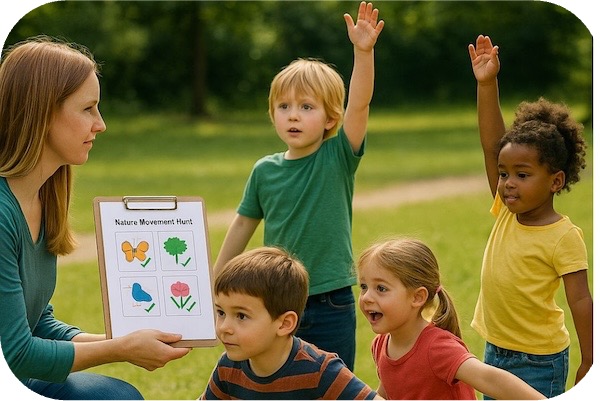
There is a playful movement challenge: children might hop, crawl, or tiptoe while looking.
As they explore, the teacher encourages careful observation and helps children describe what they find. Afterward, the group gathers to sort suitable collected objects by size, texture, or color.
Which stone is smallest? Which object feels smooth? How are these leaves different?
The activity finishes with gentle stretches and breathing. Children reach upwards like trees and sway like branches.
What are children learning?
Children combine physical activity with focused attention. They practise coordination, spatial awareness, descriptive language, and comparing objects.
The teacher can observe how children adjust their movements, follow instructions, or explain similarities and differences.
Teachers can adapt the picture cards to locally available objects and encourage children to observe living plants without picking or damaging them.
👉 Download your free Environment Level 2 sample and explore all five activities with your team HERE!
The teacher makes the learning purposeful
Across these activities, children tell stories, sing, care for plants, count and move.
Clear objectives help teachers recognise the learning within these experiences. A child’s explanation, question or change of approach can reveal more than a finished piece of work alone.
Teachers can document a sentence from the shared story, a child’s reasoning about a plant or an example of cooperation during the search.
Sharing these observations with parents helps explain what children are learning through play.
For owners and academic coordinators, this creates a practical basis for discussing classroom quality and supporting teachers.
From Environment to a full year of experiential learning
Environment is one of eight Kindiedays themes:
All About Me • Seasons & Weather • Animals • Community Helpers • Under the Sea • Environment • Around the World • Transportation
The Kindiedays Academic Calendar connects the themes within a structured learning journey, balancing opportunities for language, art, social and emotional development, STEM and physical development.
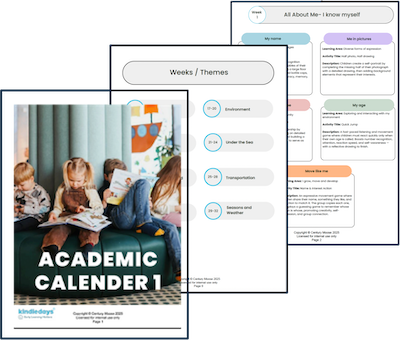
The Environment sample illustrates how one theme can support different areas of development across a week.
Ready-to-use support for teachers
Kindiedays Lesson Plans connect practical activities with learning objectives and transversal competencies such as thinking, communication and managing everyday life.
They provide materials lists, implementation steps and supporting resources. Teachers have a clear starting point while retaining space to respond to children’s interests, abilities, and discoveries.
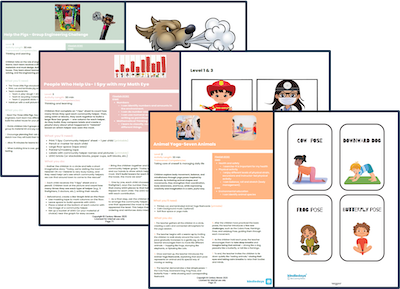
Start with the free Environment sample. Try the activities, observe the learning, and discuss with your team how the theme could work in your preschool.
Download the free lesson plans HERE!
And our journey through the themes continues…
From discovering ourselves and our communities to exploring changing weather and life beneath the waves, each theme offers a different learning context.
With Environment, children turn their attention to the places and living things around them.
Next, our journey continues with Around the World and Transportation.
The principle remains the same: children learn through active participation, while teachers guide, observe, and extend their learning. That is what makes an enjoyable preschool activity a purposeful experiential lesson.
Learn more about playful learning at Kindiedays Academy.
Happy learning!
Team Kindiedays