.png)
In our previous article, we explored how children can investigate the changing world around them through the Kindiedays Seasons & Weather theme.
Now our journey through experiential lesson plans continues with something children are always curious about:
Under the Sea 🦀🐠🐳⛵️
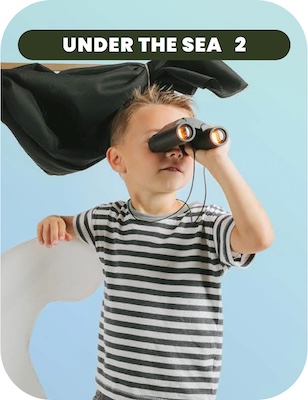
What lives in the ocean? How do waves move? Can we build a boat that floats? What colours and patterns might we discover underwater?
These questions invite children to talk, imagine, experiment, and create. They also give teachers opportunities to support language, creative expression, emotional development, scientific thinking, and movement within one connected theme.
For a preschool owner or academic coordinator, a theme's value lies in its ability to provide an engaging context for purposeful learning throughout the week.
One theme with many opportunities for learning
Under the Sea opens a world that many children have seen in pictures or stories but may never have explored themselves. Some children know the beach well. Others might connect water with rain, a pond or a bucket in the playground.
Teachers can begin with those familiar experiences and introduce the wider ocean world through stories, pictures, sensory exploration, art and imaginative play.
Children can investigate questions such as:
- What creatures live in the sea?
- How can we describe how water moves?
- Which materials float, and which sink?
- How could we help a toy penguin travel across the water?
- What textures and patterns can we create in an ocean picture?
- How can we care for the water and the creatures that live in it?
Children can suggest ideas, test them, and talk about what they discover. The teacher guides the experience while leaving room for children's choices and curiosity.
Why explore Under the Sea in preschool
The theme brings together experiences that look quite different. A conversation about a favourite object develops communication. Printing an ocean background encourages creative expression. Testing a boat gives children a practical problem to solve.
The free Kindiedays Level 2 sample, Under the Sea — Ocean Explorers, shows how these experiences can fit into a balanced week. It includes five lesson plans, each about 30 minutes long, plus a weekly overview and supporting printable resources.
The examples below come from that sample. They show both what children do and the learning teachers can support.
Download the free Under the Sea Level 2 lesson plan sample HERE!
Example 1: Show and Tell with Easy Questions
A child brings a personal object, drawing, or creation to preschool and shares it with the group. Parents are invited to send a short message about the item so the teacher can support the conversation.
The teacher welcomes each child and uses simple questions to help them explain what they have brought and why it matters. Other children listen, ask questions, and take turns.
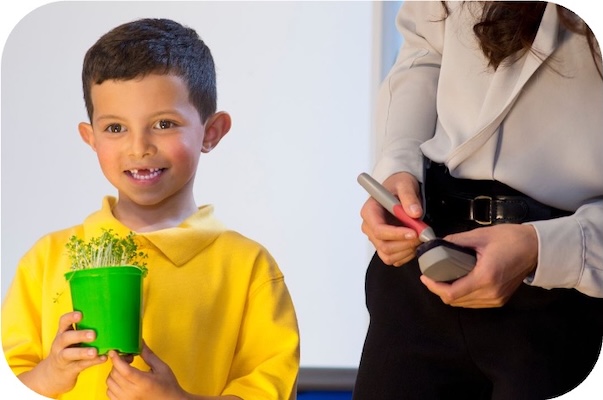
The sample allows children to share a personally meaningful item. To connect this activity more closely with Under the Sea, the teacher could invite a sea-themed drawing, toy fish, or memory of visiting the beach. This is an optional adaptation to the sample.
A child who forgets an item can choose a classroom toy or drawing, helping everyone feel included.
What are children learning?
Children practise explaining and narrating, understanding questions and listening to other people's experiences. They also have the opportunity to feel heard by the group.
The teacher can observe how a child describes an object, responds to a question, or listens to a friend. These small moments offer useful insight into communication and confidence.
The full activity and parent information printable are included in the free download.
Example 2: Fish Art with Bubble Wrap Printing
What might an ocean look like on paper?
Children begin by looking at an ocean picture and discussing its colours and fish. They then touch bubble wrap and investigate its texture before using it to print an underwater background with blue and green paint.
While the prints dry, children draw or cut fish from coloured paper. They choose shapes, sizes and decorations, then add their fish to the background. Their artworks become a shared Under the Sea Gallery.
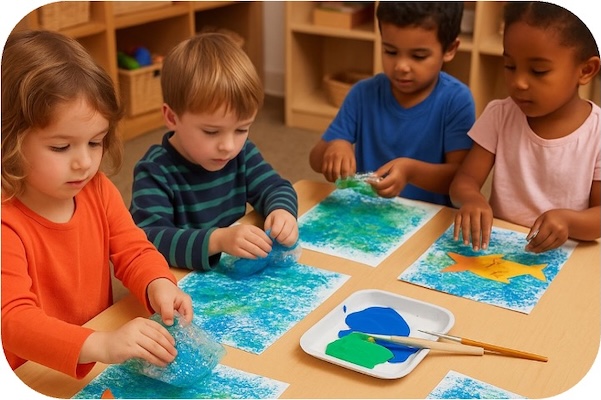
The teacher invites children to describe their creations and opens a conversation about keeping real oceans clean.
What are children learning?
Children experiment with materials and printing techniques, develop fine motor skills, and express their own ideas. They discover how a textured surface creates a pattern and make decisions about their artwork.
The teacher can ask what children noticed when they lifted the paper or why they chose a particular fish shape. The creative process offers as much to discuss as the finished picture.
Example 3: Coping with Big Emotions using a Stress Ball
The ocean theme also creates an imaginative setting for talking about feelings.
Children gather in a circle and are invited to express how they feel through words or gestures. The teacher introduces a calming stress ball, then supports the group as they mix salt dough and explore its soft, squishy texture.
With adult help, the dough is placed inside balloons, which the teacher ties securely. Children decorate their finished balls as ocean friends and discuss when they might use them to help themselves feel calm.
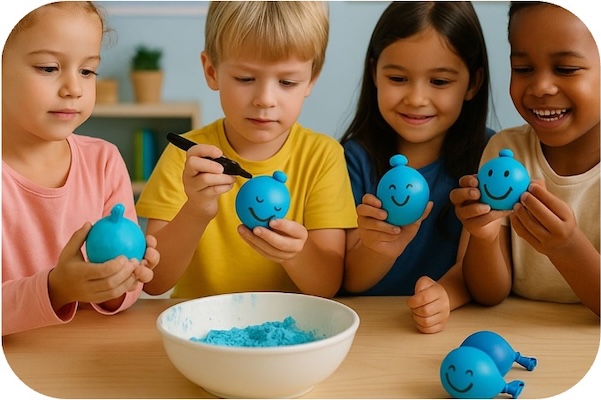
The lesson uses the image of waves washing away worries to support the conversation. Teachers can keep this gentle and voluntary, without asking children to disclose personal worries.
What are children learning?
The activity offers practice in recognising, naming and expressing emotions. With the teacher's support, children explore a possible calming strategy and language for talking about how they feel.
The adult's response matters: listening patiently, acknowledging feelings and helping children find words are central parts of the experience.
Teachers should supervise balloon use closely and select materials appropriate for their group.
Example 4: Math in the Natural World - Build a Boat for the Penguin
Can your boat carry a penguin without sinking?
The activity begins with the book Lost and Found. After discussing the journey in the story, children examine recycled materials and predict which might float.
They choose materials, design a boat, and test it in a water tray with a small penguin figure. If a boat sinks or tips over, the teacher encourages children to consider what they could change. Children then redesign and test again.
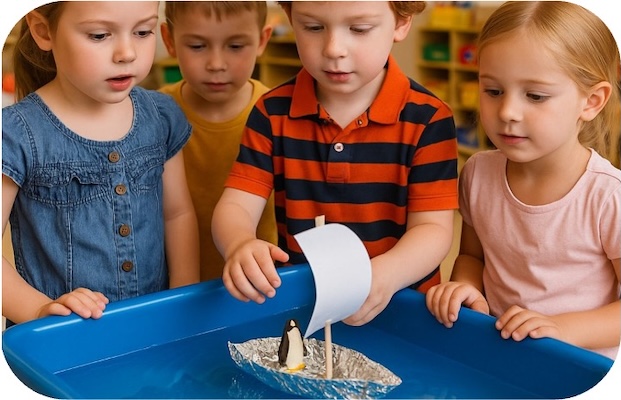
The story gives the investigation a meaningful purpose: helping a character travel across the sea.
What are children learning?
Children practise prediction, observation and problem-solving. They explore cause and effect as they see how their materials and designs behave in water.
A sinking boat creates another opportunity to investigate. Teachers can ask children to explain their next idea and allow time for another attempt.
Example 5: Ocean Parachute Fun
A large blue fabric becomes the sea. Children hold its edges and work together to create gentle waves, then change the movement to match music and ocean sounds.
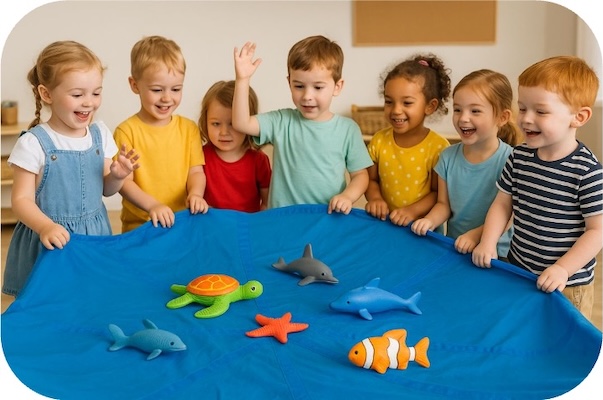
Introduce and name sea animal toys. Children watch them move on the fabric and imitate their movements. With the teacher's guidance, small groups take turns exploring beneath the raised fabric before everyone finishes with calm ocean sounds and slow waves.
What are children learning?
Children practise coordinating movement with others, listening and responding to changes in rhythm and pace. They use imagination and sea-related vocabulary while participating in a shared physical activity.
The teacher can observe how children cooperate, adjust their movements and take turns. The full Ocean Parachute Fun lesson is available as a free download.
👉 Download your free Under the Sea Level 2 sample and explore all five activities with your team.
The teacher makes the learning purposeful
Across these five activities, children speak, print, explore feelings, build and move. Each experience gives the teacher a different opportunity to support development.
Clear objectives help teachers introduce suitable materials, ask useful questions and recognise learning as it happens. Children remain active participants, choosing, investigating and expressing ideas.
Teachers can document a child's explanation, a boat redesign or a moment of cooperation. Sharing such an observation with parents helps explain the learning behind an enjoyable classroom activity.
For owners and academic coordinators, this provides a practical foundation for discussing quality with teachers and making that quality visible to families.
From Under the Sea to a full year of experiential learning
Under the Sea is one of eight Kindiedays themes:
All About Me • Seasons & Weather • Animals • Community Helpers • Under the Sea • Environment • Around the World • Transportation
The Kindiedays Academic Calendar brings the themes together into a structured learning journey. Each week balances different areas of holistic development:
- Monday: Linguistic Development
- Tuesday: Art Education
- Wednesday: Social and Emotional Development
- Thursday: STEM
- Friday: Physical Development and Food
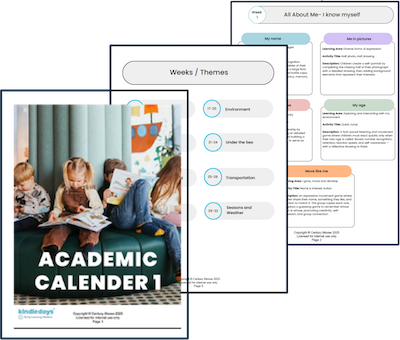
The Ocean Explorers sample illustrates balance in one week, giving teachers a connected starting point they can adapt to their children and setting.
Ready-to-use support for teachers
Kindiedays lesson plans connect practical activities with learning areas, objectives and transversal competencies such as thinking, communication and managing everyday life.
They provide activity descriptions, materials lists, supporting printables and implementation steps. Teachers can use this guidance to prepare, then adapt their interactions to the children's interests, abilities and responses. That leaves more time to observe, interact with, and support children.
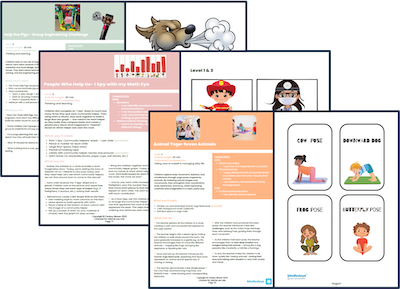
Explore Kindiedays Lesson Plan Library, Academic Calendar, and Lesson Plans.
And our journey through the themes continues...
We've explored how experiential learning can help children discover themselves through All About Me, the animal world through Animals, their society through Community Helpers, the changing world around them through Seasons & Weather, and the world beneath the waves with Under the Sea. Click to read the previous articles.
And there are still three Kindiedays themes to discover:
🌱 Environment
🌍 Around the World
🚗 Transportation
Each one provides a completely different learning context. But the principle remains the same.
Children learn by doing, exploring, communicating, creating, and discovering—while the teacher makes sure that behind the play there is purposeful learning.
That is what turns a fun preschool activity into a true experiential lesson.
Learn more about playful learning at Kindiedays Academy.
Happy learning!
Team Kindiedays