.png)
Part 5/6 in a series by Kindiedays co-founder Jessi van der Burgh.
Pedagogical documentation has long been used in early childhood education. What has changed is how it is done — and how well it fits into everyday practice.
For many educators, documentation still brings up feelings of:
- Extra workload
- Paperwork after hours
- Pressure to write “perfect” notes
In most cases, this experience comes not from pedagogical documentation itself, but from the old ways of doing it.
Understanding the difference between old and new approaches helps clarify how documentation can support learning without overwhelming educators.

The old way: documentation as a task
Traditionally, pedagogical documentation often meant:
1️⃣ Taking photos with a camera
2️⃣ Downloading them to a computer
3️⃣ Printing, cutting, and gluing them into portfolios
4️⃣ Writing observations by hand
5️⃣ Repeating the process separately for each child
While the intention was pedagogical, the process was heavy, and the documentation was done long after the learning moment.
Documentation became something educators did after learning, rather than something that supported learning as it happened.
The new way: documentation as part of pedagogy
Modern pedagogical documentation is integrated into daily practice. Instead of being a separate task, it becomes part of how educators:
Observe children -> Reflect on learning- > Plan next steps -> Share with families
The focus shifts from:
“What did we do today?”
to
“What did children learn here?”
Documentation becomes a pedagogical tool, not an obligation.
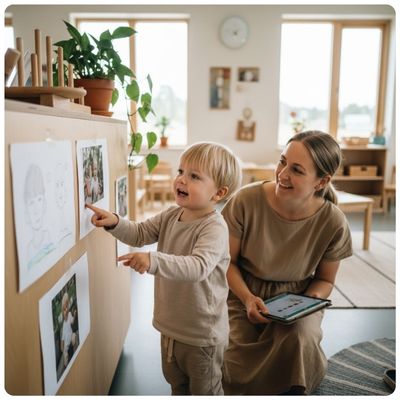
A concrete comparison
Old way
- Activity: Painting
- Documentation: “Children painted today.”
New way
- Activity: Painting
- Documentation: “While painting, children experimented with colour mixing and talked about their ideas with peers, showing curiosity and language development.”
The activity is the same. The understanding of learning is deeper.
Time and effort: what really changes?
A common concern is that pedagogical documentation takes too much time. In practice, the experience depends almost entirely on how documentation is done.
| Old Way | New Way |
|---|---|
|
|
Small, frequent documentation reduces the pressure to “catch up later”.
The role of technology: reducing friction, not replacing pedagogy
The shift from old ways to new ways of pedagogical documentation has been supported not only by changes in thinking but also by changes in tools. Modern digital documentation tools remove much of this friction.
Today, educators can:
1️⃣ Take a photo during free play or a planned activity
2️⃣ Tag a child or a group in one step
3️⃣ Connect observations to pre-aligned learning areas and objectives
4️⃣ Add a short reflective note
5️⃣ Share learning with families immediately
This entire process can take less than 2 minutes.
Importantly, the pedagogy has not changed — only the way and effort required to document it.
By removing unnecessary manual work, technology allows educators to focus on what matters most: observing learning, reflecting on development, and intentionally supporting children.
Platforms like Kindiedays are designed to support this integrated approach, helping educators stay aligned with curriculum goals while keeping documentation realistic and sustainable in everyday practice.
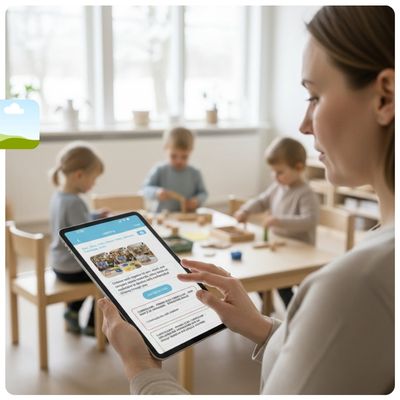
👉 WATCH VIDEO! to see how Kindiedays simplifies pedagogical documentation.
Supporting holistic education
Modern documentation practices also support holistic development.
When educators reflect on learning, using curriculum learning areas, they are more likely to notice:
- Social and emotional learning
- Language development
- Thinking and problem-solving
- Physical development
- Creativity and expression
This helps ensure that all areas of development are valued — not only the ones that are easiest to document.
Change takes time — and that’s okay
Moving from old ways to new ways does not happen overnight.
What matters is:
- Starting small
- Focusing on meaningful moments
- Building habits gradually
- Supporting educators through change
Pedagogical documentation is a practice that grows with confidence.
In summary
The difference between old and new ways of pedagogical documentation is not technology alone — it is purpose. Old ways focused on reporting; new ways focus on learning.
When documentation becomes part of everyday pedagogy, it:
- Saves time
- Improves quality
- Strengthens reflection
- Supports children’s learning
Coming next in this series
In the final blog, we address the question many educators and leaders are asking:
Is pedagogical documentation really worth the time and effort?
What next?
👉 Learn how Kindiedays can support you with a complete Curriculum Partnership.

I look forward to meeting you.
Milla van der Burgh
👉 Click here to schedule a consultative call on Zoom or contact me on WhatsApp!
PS Join our official WhatsApp group 👉 click here to join the group!
Check the full series
This six-part series explores (click the link to explore the previous blogs):
- Why pedagogical documentation matters
- How it works in the Finnish context
- How goals support play without limiting it
- How documentation deepens learning beyond the classroom
- How practice has evolved from old ways to new ones
- Why is the effort worth it