.png)
Part 3/6 in a series by Kindiedays co-founder Jessi van der Burgh. If you missed the start of the series, please explore Part 1 and Part 2.
Understanding Objectives Without Limiting Children
One of the most common questions in early childhood education is also one of the most misunderstood:
Do play-based activities need learning goals or objectives?
- Some educators worry that goals will turn play into instruction.
- Others worry that without goals, learning becomes random or hard to explain.
High-quality early childhood education — including the Finnish approach — demonstrates that both concerns can be addressed simultaneously. The key lies in who the goals are for.
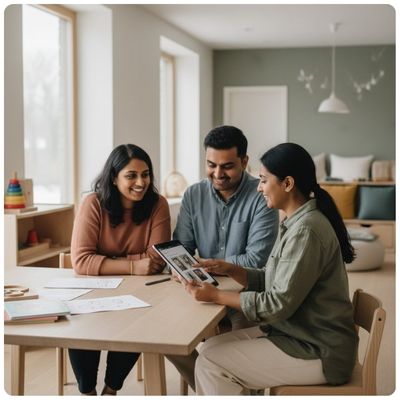
A crucial distinction: goals guide educators, not children
In play-based pedagogy, children do not play to meet objectives.
Children play to:
- Explore
- Imagine
- Test ideas
- Interact with others
- Follow curiosity
Learning goals exist for educators, not for children.
They help educators:
- Observe learning more clearly
- Reflect on what is happening
- Ensure holistic development
- Stay aligned with curriculum expectations
When used correctly, goals do not limit play — they make learning visible.
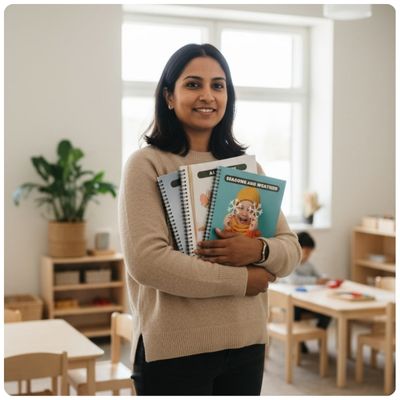
Play-based, experiential lesson plans with clear learning objectives support teachers' work and provide a clear structure for learning.
What happens when there are no pedagogical goals?
When activities are not connected to learning goals or curriculum areas, documentation often becomes:
- Random
- Activity-focused
- Uneven across learning areas
Some types of learning may be documented frequently (e.g., creativity), whereas others are unintentionally overlooked (e.g., language, social development, or thinking skills).
Goals help educators ask better questions:
- What learning is happening here?
- Which areas of development are being supported?
- What might need more attention?
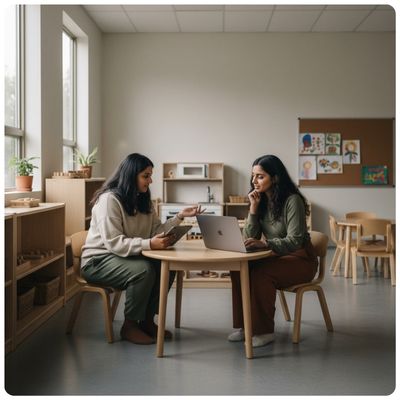
Play remains open — observation becomes intentional
Let’s look at a concrete example.
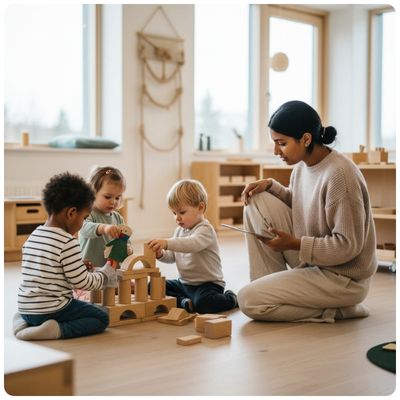
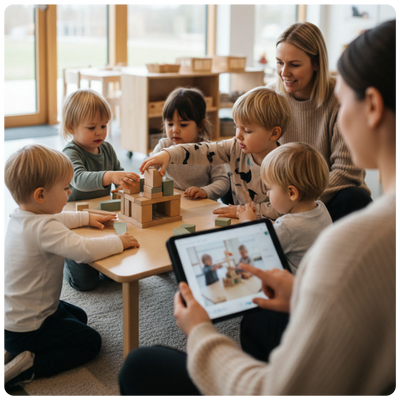
Example: Free play with blocks
Children are freely building towers and structures.
There is no instruction and no expected outcome.
From the child’s perspective:
- They are experimenting
- Collaborating
- Solving problems
- Enjoying play
From the educator’s perspective:
- Problem-solving skills are emerging
- Early mathematical thinking is visible
- Social interaction and negotiation are happening
The play is child-led.
The observation and reflection are educator-led.
Learning goals help educators recognise and articulate what is happening — after or alongside the play, not instead of it.
Curriculum objectives as a support, not a checklist
In high-quality early childhood education systems, curriculum objectives are not targets children must achieve. They are reference points for educators.
They support educators to:
- Reflect on learning
- Ensure balanced, holistic education
- Avoid focusing on only one type of development
- Make pedagogy visible to families and teams
This is especially important in play-based environments, where learning is rich but often informal.
Observation first, goals second
A key principle in pedagogical documentation is observation before interpretation.
The sequence matters:
- Children play, explore, and interact
- Educators observe and document meaningful moments
- Learning areas or objectives are identified based on what was observed
- Reflection informs future planning
When goals are applied after observation, they support learning instead of directing it.
Supporting holistic development
Early childhood education supports many areas of development at the same time:
- Language and communication
- Social and emotional development
- Physical and motor skills
- Thinking and problem-solving
- Creativity and expression
Without curriculum-aligned reflection, some of these areas can be overlooked.
Learning goals help educators ensure that all children receive balanced support, even though learning happens through play.
Understanding development, not judging children
In formative pedagogical documentation, educators may reflect on whether a child:
- Needs support
- Is managing
- Is succeeding in a particular area
This is not assessment or grading.
It helps educators:
- Notice patterns over time
- Identify when support is needed
- Reflect on the effectiveness of pedagogy
The focus remains on supporting learning, not measuring performance.
Why this matters for families
Families often ask:
- “What is my child learning?”
- “How does play support development?”
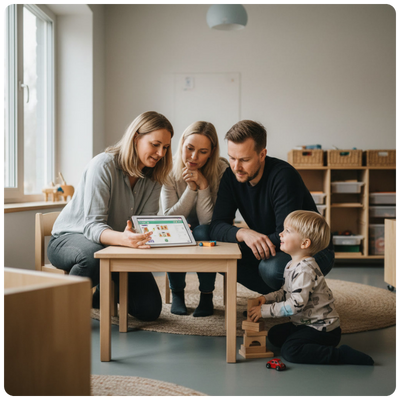
When educators can connect observations to learning goals, they can communicate clearly and confidently.
This helps families:
- Understand the value of play-based learning
- Engage in meaningful conversations with their child
- Trust the educational approach
Goals make learning explainable without becoming rigid.
Play-based learning and intentional pedagogy belong together
The strongest early childhood pedagogy combines:
- Child-led play
- Educator-led reflection
- Curriculum-aligned goals
This balance protects children’s freedom while ensuring educational quality.
Play stays playful.
Learning becomes visible.
In summary
Play-based activities do not need goals for children, but educators need goals to understand learning.
When used thoughtfully:
- Goals guide observation, not behaviour
- Play remains open-ended
- Learning becomes visible and meaningful
- Education stays holistic and intentional
High-quality early childhood education is not about choosing between play and goals.
It is about holding both together.
"Implementing an Integrated Indian and Finnish curriculum has enriched our curriculum, emphasizing play-based learning. With incorporation of Finnish Lesson Plans, Learning Objectives and Kindiedays Digi Tools, we've differentiated ourselves in the market. Parents recognize the value of our educational philosophy, leading to improvement in admissions." says Saliil Arakkal, CEO, Globetrotter Kids, India.
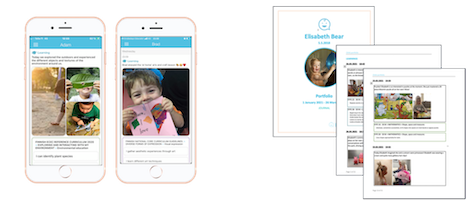
📽️ Watch how Kindiedays Pedagogical Management Solution Supports Teachers
Coming next in this series
In the next blog, we examine how pedagogical documentation deepens learning beyond the classroom—when children revisit their learning at home and become active participants in sharing what they know.
See you then ❤️

Jessi van de Burgh
jessi@kindiedays.com
Check the full series
This six-part series explores (click the link to explore the previous blogs):
- Why pedagogical documentation matters
- How it works in the Finnish context
- How goals support play without limiting it
- How documentation deepens learning beyond the classroom
- How practice has evolved from old ways to new ones
- Why is the effort worth it