.png)
Part 4/6 in a series by Kindiedays co-founder Jessi van der Burgh.
Pedagogical documentation does not stop learning at the classroom door. When documentation is shared with families and revisited with children, learning continues, deepens, and gains new meaning.
What began as play or exploration in an early childhood setting becomes a shared story — one that children reflect on, explain, and reconnect with.
This home–school connection is one of the most powerful and often overlooked impacts of pedagogical documentation.
Learning does not end when the activity ends
In early childhood education, learning happens in moments:
- During play
- Through interaction
- In conversation
- In problem-solving
But learning deepens when children revisit experiences.
Pedagogical documentation makes this possible by:
- Capturing meaningful moments
- Preserving them beyond the activity
- Allowing children and adults to return to them later
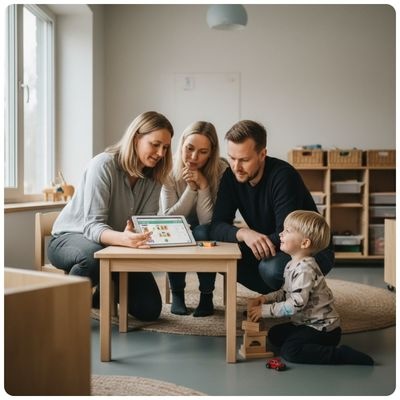
When children see photos, notes, or learning stories from their day, they are reminded of what they did — and begin to reflect on it.
From experiencing learning to explaining learning
In early childhood settings, children often learn through shared experiences supported by teachers. At home, something interesting happens.
When families ask:
- “What were you doing here?”
- “What did you like about this?”
- “How did you build that?”
The child takes on a new role. They are no longer only experiencing learning — they are explaining it.
This shift supports:
- Language development
- Memory and understanding
- Confidence
- Meaning-making
Explaining learning helps children organise their thoughts and deepen understanding, even at a very young age.
.jpg)
Learning across contexts: centre and home
In high-quality early childhood education, learning is not limited to one place.
Teachers support deeper learning by:
- Documenting meaningful moments, not everything
- Writing notes that invite reflection
- Including children’s voices or ideas
- Sharing documentation regularly with families
Small, thoughtful documentation practices can have a large impact on learning.
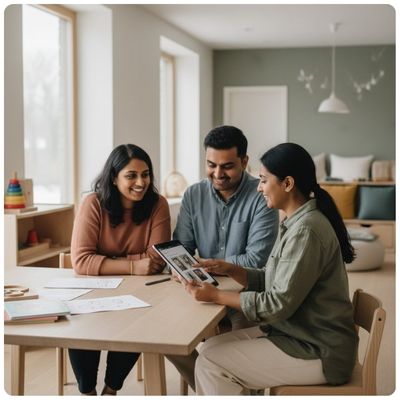
When documentation is shared with families:
- Learning becomes visible at home
- Families understand what children are exploring
- Conversations continue beyond the centre
This creates continuity between early childhood education and family life.
Children experience learning as meaningful and connected—not something that only happens “at school”.
Strengthening children’s agency and identity
Seeing their learning documented sends a powerful message to children:
- “What you do matters.”
- “Your ideas are important.”
- “Your learning is worth sharing.”
When children recognise their own learning experiences, they:
- Develop confidence
- Feel ownership over learning
- Become more willing to explore and try again
Pedagogical documentation supports children’s identity as learners — not by measuring them, but by valuing their experiences.
Why this matters for families
Families often want to support their child’s learning but are unsure how.
Pedagogical documentation helps by:
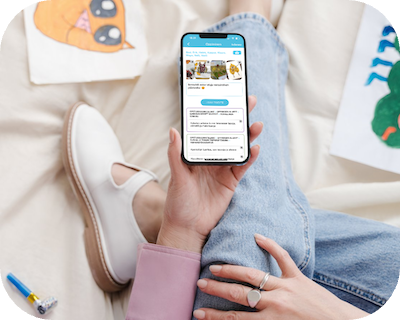
- Showing what children are learning through play
- Offering concrete moments to talk about
- Making learning understandable and relatable
Instead of asking general questions like “How was your day?”, families can ask about specific moments, materials, or ideas.
This leads to richer conversations and stronger engagement.
In summary
Pedagogical documentation deepens learning because it:
- Extends learning beyond the moment
- Supports reflection and language development
- Strengthens the home–school connection
- Builds children’s confidence and agency
- Makes learning meaningful across contexts
It transforms learning from a moment into a journey.
Coming next in this series
In the next blog, we compare old and new approaches to pedagogical documentation and explore how practice has evolved over time.
What next?
👉 Learn how Kindiedays can support you with a complete Curriculum Partnership.

I look forward to meeting you.
Milla van der Burgh
👉 Click here to schedule a consultative call on Zoom or contact me on WhatsApp!
PS Join our official WhatsApp group 👉 click here to join the group!
Check the full series
This six-part series explores (click the link to explore the previous blogs):
- Why pedagogical documentation matters
- How it works in the Finnish context
- How goals support play without limiting it
- How documentation deepens learning beyond the classroom
- How practice has evolved from old ways to new ones
- Why is the effort worth it