.png)
How can you turn play-based learning into a consistent experience for children, teachers, and parents?
Most private preschools have a clear vision for the children in their care. They want joyful classrooms, confident teachers and children who are curious, capable and ready for the next stage of learning. Their websites often promise child-centred, experiential or play-based education.
The hard part comes after that promise. What will happen in every classroom on Monday morning? Will a new teacher know how to put the approach into practice? Will parents understand what their child learned while playing? And can the owner or Academic Coordinator see whether the intended quality is being delivered consistently?
These are practical questions for any preschool that wants its educational promise to mean something in daily life. They also affect the trust families place in the preschool and the confidence with which staff can represent it.
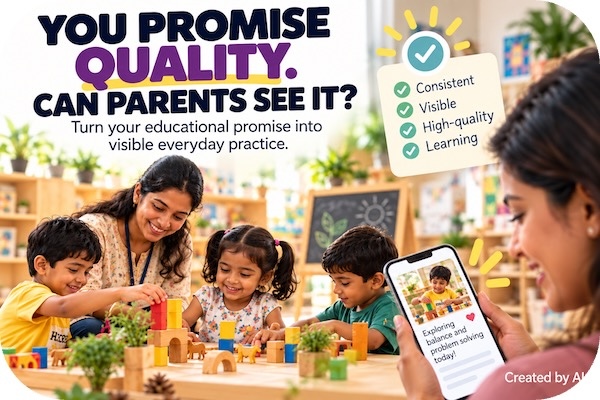
The gap between a curriculum and a classroom
A curriculum can describe what children should learn. It cannot, on its own, tell a teacher what to do when 20 children arrive, materials are limited, and the day is already busy.
Imagine a teacher planning a theme on community helpers. The goal might include communication, cooperation, and understanding the people who help in the neighbourhood. But the teacher still needs to decide how to introduce the theme, which questions to ask, how children will participate, what to observe, and how to adapt the activity for different ages.
Without practical support, even a good curriculum can be implemented unevenly. An experienced teacher may create a rich role-play activity. Another may fall back on a worksheet. A third may organise enjoyable play but struggle to explain its learning purpose. When a teacher leaves and a replacement joins, the variation can become greater.
For the owner, this creates a difficult question: Does the experience children receive match the education we promise parents?
Teachers need a way to teach well every day
Teachers are central to quality, but they cannot be expected to invent every activity from scratch. A workshop alone also doesn't guarantee new ideas become daily habits.
Teachers need both professional understanding and practical guidance. It helps to know the learning objective, have a suitable activity ready, understand how to guide the children, and recognise what their responses reveal about their development. They also need time to prepare and a simple way to record useful observations.
This is where the two parts of Kindiedays work together. Kindiedays Academy helps teachers understand and apply Finnish-inspired, play-based early education. The Kindiedays Learning System gives them an Academic Calendar, learning objectives, age-appropriate lesson plans, and digital tools to support the work throughout the year.
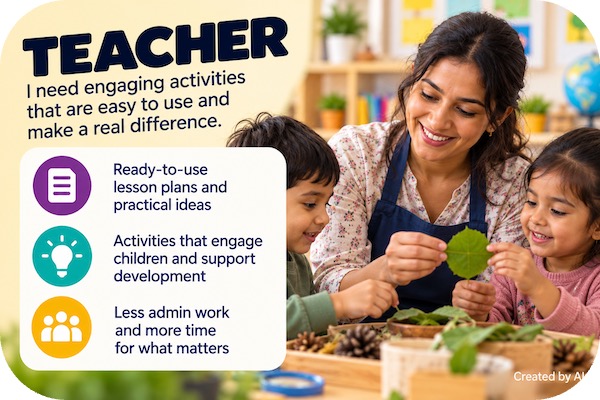
For example, the teacher can select a Community Helpers lesson suited to children aged 4–5, prepare the materials, guide a purposeful activity, and observe how the children communicate and cooperate. The plan provides a starting point; the teacher still responds to the interests, needs, and ideas of the children in front of them.
The result is a more dependable way to put educational aims into practice, while leaving room for teachers' judgment and creativity.
Academic leaders need to see what is being implemented
An Academic Coordinator or Centre Head may have carefully planned the term, but plans are useful only if they reach the classroom. Leaders need to support teachers, notice where help is needed, and keep learning experiences coherent across age groups.
This becomes harder as a preschool grows. Walking into a classroom occasionally gives only a brief impression. Reviewing a stack of weekly plans says little about how children responded. Asking teachers to prepare lengthy reports can take them away from teaching.
A shared Academic Calendar and Lesson Library give staff a common structure. Learning objectives help the coordinator discuss why an activity matters, as well as what took place. Observations and documentation create a clearer picture of children's experiences. Manager Tools can help leaders review activity planning and documentation and decide where to offer support.
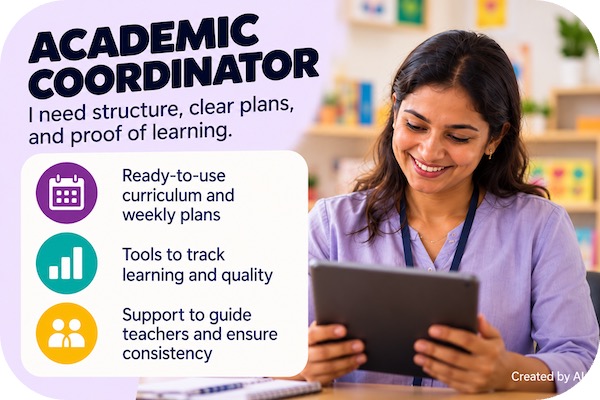
This does not replace classroom visits, conversations with teachers, or professional judgment. It gives those conversations a more useful basis. A coordinator can ask: “What did you notice during this activity? Which children need another opportunity? What should we try next week?”
That is more valuable than simply checking whether a lesson was marked complete.
Parents want to understand what their child is learning
Parents see only part of a preschool day. A child may spend the morning negotiating roles in a pretend shop, comparing quantities, making signs and learning to take turns. At collection time, the child might simply say, “We played shop.”
The parent may appreciate that the child was happy, yet still wonder what the experience contributed to learning. A photo of the activity is pleasant, but a brief explanation makes it more meaningful:
“The children created a shop together today. They sorted items, used language to ask and answer questions, and practised taking turns. We noticed how your child explained an idea to a friend.”
Now the parent can see the link between play and development. Over time, observations and a child's portfolio can show progress that is difficult to capture through worksheets or performances alone: growing confidence, communication, collaboration, creativity and independence.
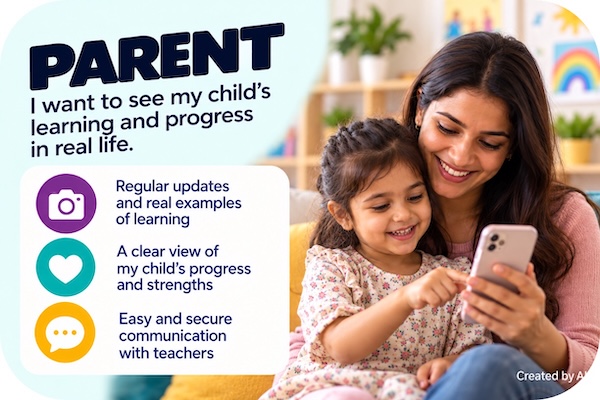
The Kindiedays Educator and Family Apps support this connection between classroom experiences and parent communication. The aim is to share relevant evidence of learning clearly and respectfully, so parents can understand the value of the education their child receives.
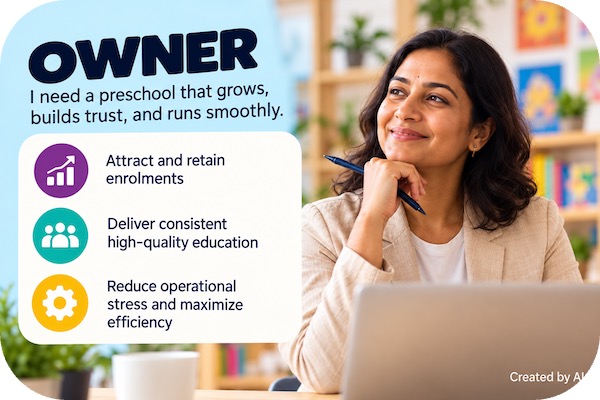
Owners need an educational promise they can demonstrate
Many preschools describe themselves with similar words: holistic, experiential, child-centred and play-based. Parents may hear these phrases repeatedly when comparing schools. The stronger question is: What can you show them?
An owner can explain the preschool's approach with greater confidence when trained teachers, planned learning experiences, meaningful observations, and communication with families support it. During a parent orientation or admissions conversation, the school can show how an activity connects to a learning objective and how teachers notice children's progress.
That does not mean an app or a set of lesson plans will automatically bring more admissions. Families consider many things, including location, safety, relationships and fees. But a school that can explain and demonstrate its everyday educational practice has a more credible story to tell. Existing parents can also understand more clearly what makes their child's experience valuable.
For a multi-centre operator, there is another consideration: whether the same educational promise is delivered across different teams and locations. A common approach to training, planning, observation and review makes quality easier to support as the organisation grows.
From a promise to a repeatable practice
The challenge is not a shortage of educational aspirations. It is connecting those aspirations to what teachers, leaders, children and parents experience each day.
A workable process looks like this:
- Develop teachers' understanding of purposeful, play-based learning.
- Plan from clear objectives using an Academic Calendar and suitable lesson plans.
- Guide activities with flexibility so children can explore, participate, and contribute ideas.
- Observe what children do and say, rather than relying only on completed work.
- Document meaningful progress and share it with families.
- Review implementation and help teachers improve the next learning experience.
Kindiedays Academy and the Learning System support this whole process. Academy develops the people who deliver the education. The Learning System helps the team plan, deliver, observe learning, communicate with families, and review quality.
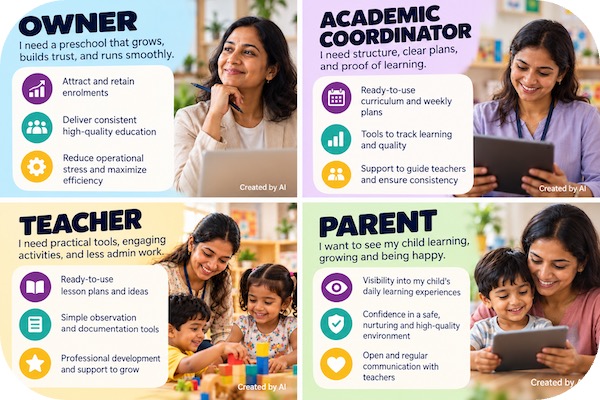
For teachers, this means more guidance and confidence. For academic leaders, it means a clearer view of implementation. For parents, it means a better understanding of their child's learning. For owners, it means that the preschool's educational promise can be demonstrated through everyday practice.
A strong preschool experience is built one day at a time. When teachers have the right support, and parents can see the learning behind children's activities, quality becomes something the whole preschool can understand, practise and improve.
Would you like to see how Kindiedays could support your preschool team? Explore the Kindiedays Learning System and arrange a conversation with us.
What next?
👉 Learn more about how Kindiedays can support your preschool by combining Finnish early education principles, digital tools, lesson plans, and teacher workshops tailored for challenger preschools.

I look forward to meeting you.
Milla van der Burgh
👉 Click here to schedule a consultative call on Zoom or contact me on WhatsApp!
PS Join our official WhatsApp group 👉 click here to join the group!