.png)
Part 2/6 in a series by Kindiedays co-founder Jessi van der Burgh.
What It Means and Why It Works
Finland is widely recognised for its high-quality education system, and this reputation begins in early childhood education. One of the key practices supporting quality in Finnish early childhood education and care (ECEC) is pedagogical documentation.
In Finland, pedagogical documentation is not an administrative task or a way to prove compliance. It is a practical pedagogical tool that helps educators understand children’s learning, reflect on their own practice, and ensure that education supports the whole child.
Understanding how pedagogical documentation is used in the Finnish context clarifies why it works—and how its principles can be applied elsewhere.
How Finland understands early childhood education
Finnish early childhood education is based on a few core principles:
- Children are active participants in their own learning
- Learning happens through play, interaction, and everyday experiences
- Education supports the whole child — socially, emotionally, physically, and cognitively
- Quality depends on reflection, not control
Pedagogical documentation supports these principles by helping educators observe learning in real time and respond thoughtfully.

What pedagogical documentation means in Finland
In the Finnish context, pedagogical documentation is a continuous process that helps educators to:
- Observe children’s learning and development
- Understand children’s interests, strengths, and needs
- Plan and adapt pedagogical activities
- Evaluate and improve practice
- Support collaboration within educator teams
- Build shared understanding with families
Documentation is not done at the end of learning. It is part of everyday practice and informs the next steps.
Documentation as a pedagogical tool — not a report
A key reason pedagogical documentation works in Finland is that it is used, not just stored.
Educators regularly reflect on documentation by asking:
- What does this observation tell us about the child’s learning?
- What is emerging or developing?
- How can we support the next step?
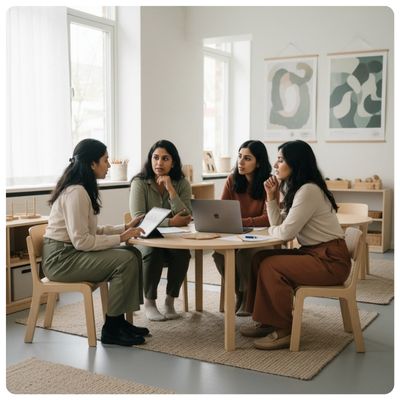
This reflection may happen individually or as part of team discussions. Documentation becomes a starting point for pedagogical decision-making, not a record kept for external purposes.
Curriculum alignment without limiting children
Finnish early childhood education is guided by the National Core Curriculum for ECEC. This curriculum outlines learning areas and objectives that support holistic development.
In practice, this means:
- Educators work with curriculum goals in mind
- Children are not expected to “achieve” objectives
- Goals guide observation and reflection, not children’s behaviour
Children are free to play, explore, and lead their learning. Educators use curriculum objectives to recognise learning when it happens, whether during free play or planned activities.
This balance ensures that education is both child-centred and intentional.
Children’s participation and voice
In Finnish pedagogy, children are seen as capable learners whose experiences matter.
Pedagogical documentation often includes:
- Children’s words and ideas
- Questions children ask
- Reflections shared in age-appropriate ways
When children see their learning documented, they gain:
- A sense of being seen and valued
- Opportunities to reflect on experiences
- Confidence in sharing their ideas
Documentation supports children’s agency rather than reducing them to outcomes or assessments.
Collaboration with parents
Finnish early childhood education places strong emphasis on cooperation with parents.
Pedagogical documentation helps families:
- Understand what and how their child is learning
- See the value of play-based education
- Engage in meaningful conversations with their child
Instead of receiving general updates, families gain insight into learning processes. This strengthens trust and supports continuity between home and early childhood education.

Why the Finnish approach works in Finland and globally
Pedagogical documentation works in Finland because it is:
- Integrated into everyday practice
- Focused on reflection rather than control
- Used to support educators, not evaluate children
- Aligned with the curriculum while protecting play
- Sustainable over time
It respects both children and educators as active participants in the learning process.
"Learning happens when children play and explore together. The educators document the children’s play, as observation of the play gives a lot of information about children’s world, their thoughts, interests, emotions, and experiences. The educators can then provide the earliest support when needed." says M Maryum Nawaz, Manager Best Kidz, Dubai.
What can be learned from the Finnish context?
The value of the Finnish approach is not in copying it exactly, but in understanding its principles:
- Documentation should support learning, not add burden
- Goals guide educators, not children
- Reflection improves quality
- Collaboration strengthens practice
These principles are relevant across cultures and education systems.
In summary
In the Finnish education context, pedagogical documentation:
- Is a core part of quality early childhood education
- Supports intentional, reflective pedagogy
- Makes learning visible without limiting children
- Strengthens collaboration with families
- Supports continuous improvement
It works because it is purposeful, practical, and human.
👇 See the video on how pedagogical documentation works in practice with Kindiedays.
📽️ Planning, documentation, and assessment of playful learning - intro to Workshop
Coming next in this series
In the next blog, we explore a common question in early childhood education:
Do play-based activities need learning goals — and how can objectives support learning without limiting children?
See you then
Jessi van de Burgh
jessi@kindiedays.com
Check the full series
This six-part series explores (click the link to explore all blogs):