.png)
A practical guide for teachers – with a real classroom example by Kindiedays Education Expert Stella Giota.
Playful, experiential learning is not about spontaneous activities or “free play without purpose.”It follows clear pedagogical steps—but the steps guide the process, not the outcome.
Below, each step is first explained in principle and then illustrated in practice through a month-long restaurant project.
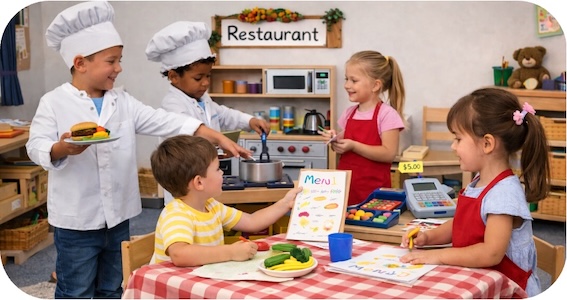
STEP 1: Start With Children’s Ideas and Prior Knowledge
The principle
Experiential learning always begins with:
1️⃣ What children already know
2️⃣ What they believe (including misconceptions)
3️⃣ What they are curious about
The teacher’s role is to listen before planning.
Restaurant Example in practice
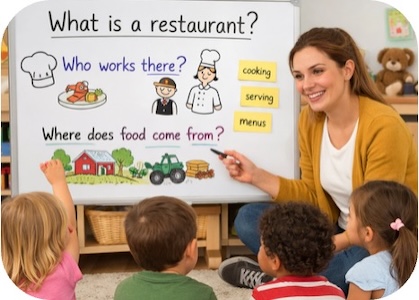
The teacher invites a group discussion:
- “What is a restaurant?”
- “Who works there?”
- “Where does food come from?”
Children share experiences, ideas, and questions.
The teacher documents their thinking and uses it as the starting point for the project.
STEP 2: Define Broad Learning Intentions (Not Activities)
The principle
Teachers clarify what kinds of learning they want to support, without deciding how children must learn it.
Learning intentions might include:
- language and communication
- collaboration
- early math and literacy
- understanding the world
- self-regulation
Restaurant Example in practice
From the discussion, the teacher notices strong interest in:
- food
- roles in a restaurant
- buying and selling
These interests shape the learning intentions—but not a fixed plan.
STEP 3: Prepare the Environment as the “Third Teacher”
The principle
In playful learning, the environment does much of the teaching.
Instead of a single activity table, the entire classroom becomes a project space.
Restaurant Example in practice
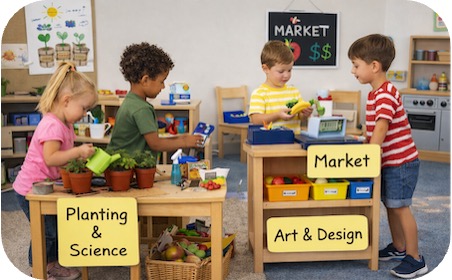
The classroom gradually transforms for the restaurant project.
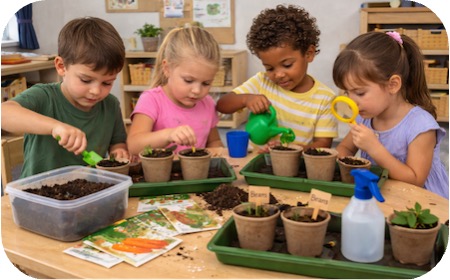
Planting & Science Area → “Where Does Our Food Come From?”
This area supports exploration and inquiry.
Children:
- plant vegetable and herb seeds
- test what plants need to grow (water, light, soil, air)
- observe changes and document growth
- talk about where restaurant food comes from
This area connects the restaurant to nature, science, and real life.
Market Corner → “Buying and Selling Food”
This area supports math, language, and social interaction.
Children:
- sort fruits and vegetables
- role-play buying and selling
- use numbers, quantities, and money
- practise negotiation and communication
The market serves as the bridge between food production and restaurants.
Art & Design Area → “Preparing the Restaurant”
This area supports creativity and planning.
Children:
- design signs for the restaurant
- make tablecloths, aprons, and chef hats
- create food using salt dough or recycled materials
- experiment with colours, patterns, and materials
Art becomes purposeful and connected to the project—not a separate activity.
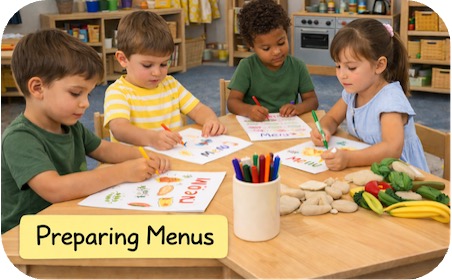
Writing & Drawing Area → “Menus, Orders, and Planning”
This area supports early literacy and symbolic thinking.
Children:
- draw and write menus
- create order notes and labels
- use symbols, letters, and numbers meaningfully
- communicate ideas through marks and drawings
Writing emerges naturally because it is needed for the play.
Dramatic Play Area → “Running the Restaurant”
This area supports social-emotional learning and role play.
Children:
- take on roles as chefs, waiters, cashiers, customers
- practise cooperation and responsibility
- negotiate rules and solve conflicts
- connect all previous learning into lived experience
This is where everything comes together.
STEP 4: Allow Learning to Unfold Over Time
The principle
Experiential learning:
- does not happen in one day
- follows the children’s pace
- allows repetition and deep engagement
Restaurant Example in practice
Over several weeks, children:
- plant seeds and observe growth
- experiment with what plants need
- harvest and wash crops
- move food to a pretend market
There is no pressure to “finish” in a specific timeline.
Learning deepens when children revisit ideas repeatedly.
STEP 5: Offer Choice and Small-Group Work
The principle
Not all children need to do the same thing at the same time.
Choice supports:
- autonomy
- motivation
- inclusion
Restaurant Example in practice
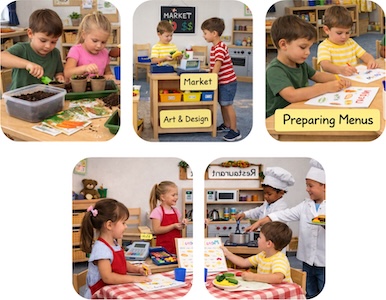
Children work in small groups on:
- food preparation with salt dough
- menu creation and early writing
- designing signs
- making tablecloths, aprons, chef hats
Groups change naturally as children finish and move on.
STEP 6: Support Role Play and Social Learning
The principle
Role-play connects learning to real life and fosters social understanding.
Teachers support roles—but do not assign meaning or scripts.
Restaurant Example in practice
Children take on different roles each day:
- chefs
- waiters/waitresses
- cashiers
- cleaners
- customers
Through play, they practise:
- communication
- cooperation
- responsibility
- empathy
STEP 7: Observe, Scaffold, and Extend
The principle
Teachers observe first, then intervene intentionally.
Scaffolding includes:
- asking open-ended questions
- adding materials
- naming emotions
- modelling language
Restaurant Example in practice
The teacher notices:
- conflicts about roles
- challenges with money or menus
- emerging literacy
Support is given only when needed, to extend—not control—the play.
STEP 8: Make Learning Visible Through Reflection
The principle
Reflection helps children understand their experiences.
Restaurant Example in practice
Children talk about:
- what they did
- what was difficult
- how they solved problems
Teachers document learning through photos, videos, notes, and conversations. They can turn these into posts that can be shared with the parents.
STEP 9: Bring Learning to the Community
The principle
Experiential learning connects school to real life.
Restaurant Example in practice
Children:
- prepare real food (toasts, apple pie)
- experience different roles (e.g., chefs, waitresses)
- invite other groups to the restaurant
- later welcome parents
The project becomes meaningful because it is shared.
What Teachers Should Take From This
Playful, experiential learning:
- follows clear steps
- requires intentional planning
- gives control to children
- values process over product
- happens over time, not tasks
Playful learning is not about doing more activities—it’s about connecting learning to real life in meaningful ways.
A Final Message to Teachers
You do not need:
- more activities
- more worksheets
- more pressure
You need:
- time
- trust
- observation
- courage to let learning unfold
That is where real learning lives.
Next Steps
For more inspiration, I warmly invite you to join the Kindiedays Academy for interactive online workshops led by me.
Access the full program and sign up HERE!
Looking forward to meeting you in the workshops ❤️

Stella Giota
stella@kindiedays.com