.png)
What Finnish evidence reveals about attendance information—and how a clearer shared picture can support ECEC planning anywhere.
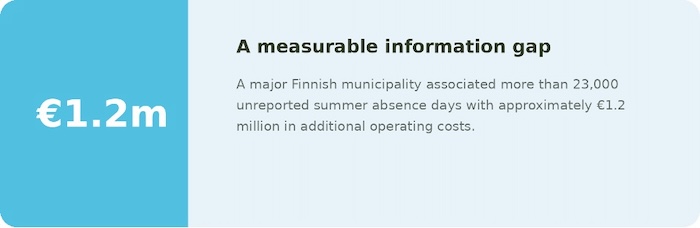
Evidence reported in June 2026 by a major Finnish municipality.
A universal operational challenge
Plans change. A child becomes ill, a family holiday moves or a parent’s work schedule changes. A childcare place may remain reserved even though it is no longer needed.
For an individual family, this is a normal change in everyday life. Across a large early childhood centre, childcare group or public ECEC system, however, the difference between expected and actual attendance can affect staffing, meal preparation, cleaning and the use of facilities.
The challenge is not that families deliberately create waste. It is that updated information does not always reach every person and system involved in planning in time.
Evidence from Finland
Recent Finnish evidence illustrates how large this information gap can become.
In June 2026, Yle reported that one major municipality recorded more than 23,000 unreported summer absence days and estimated approximately €1.2 million in additional operating costs. Staffing holidays, meals and cleaning services had been arranged using the attendance information families had previously provided.
Other Finnish municipalities have also reported substantial differences between reserved and actual attendance during holiday periods. In one municipality, reported costs connected with uncancelled reservations fell by €178,000 year on year after clearer cancellation rules and extensive family communication were introduced together. Because both measures changed at the same time, the result cannot be attributed to one intervention alone.
These examples concern holiday-period operations in Finland rather than everyday attendance throughout the year. Their wider lesson is nevertheless relevant internationally: planning becomes more difficult when expected attendance and actual care needs diverge.
Sources: Yle, 29 June 2026 and 4 September 2025 https://yle.fi/a/74-20233529 | https://yle.fi/a/74-20180922
Where do the avoidable costs come from?
1. Staffing and substitute planning
Separate staffing and attendance records make it hard to reconcile changing care needs.
ECEC providers must maintain sufficient staffing for the children who attend. Work shifts, leave and substitute requirements therefore depend on expected attendance. If absence updates remain in separate messages, paper records or disconnected systems, leaders may have to make staffing decisions using information that is already incomplete.
In Finland, the Association of Finnish Cities and Municipalities has reported that incomplete absence information led some centres to arrange substitutes who were ultimately not required because not all expected children attended.
Source: Association of Finnish Cities and Municipalities, 29 January 2025 https://www.kuntaliitto.fi/tiedotteet/2025/varhaiskasvatuksen-jarjestamiskustannukset-ovat-nousseet-merkittavasti
2. Meals and food waste

More accurate attendance numbers can support meal ordering and preparation.
Meals are ordered or prepared before the final attendance number is known. Research from the Natural Resources Institute Finland found that food waste in the measured daycare centres amounted to 20–30% of prepared food; a related monitoring project measured approximately 27%. Most was serving waste connected with overproduction or over-ordering. Uncertainty about the number of attending children was identified as one reason food is prepared with a safety margin.
This does not mean that all ECEC food waste is caused by unreported absences. Menu design, portion forecasting and normal variation in children’s appetites also matter. Better attendance information can nevertheless support more accurate meal planning.
Source: Natural Resources Institute Finland, Lahti & Silvennoinen, 2020 https://urn.fi/URN:ISBN:978-952-326-904-0
3. Facilities, services and quieter operating periods
Päiväkoti Silkkiuikku, a quiet early childhood centre during a low-attendance period.
When expected attendance is known early enough, providers can decide which rooms, groups or locations need to operate, align staff leave with quieter periods and order cleaning or other services for the facilities that will actually be used. Reservations that remain in the system “just in case” reduce that opportunity.
Make changing care needs easier to communicate
Attendance reporting needs to be simple for families and connected to the tools educators already use. Families need a straightforward way to add expected drop-off and pick-up times, record one-day or longer absences and update information when plans change.
Educators need a clear daily and forward-looking view without searching through separate messages. Centre leaders and managers need current attendance information and exportable reports to support staffing, catering and operational decisions.
How Kindiedays creates a shared attendance picture
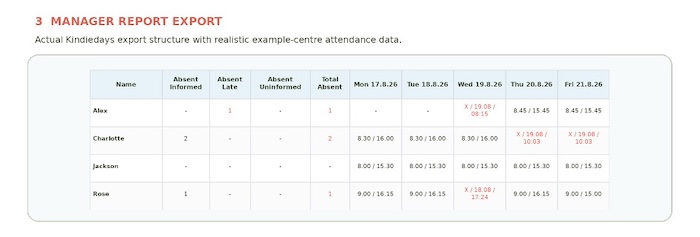
Kindiedays connects attendance information from the Family App to the Educator App and manager reports. Families can add future attendance times and record absences with a reason and optional details. Educators can see expected absences, view planned drop-off and pick-up times, and check future calendar dates. Managers can review and export attendance information for operational planning.
No digital tool can guarantee savings, and attendance information is only one part of workforce, meal, and facility planning. Kindiedays provides a clearer shared information flow so decisions can be based on the most current information available.
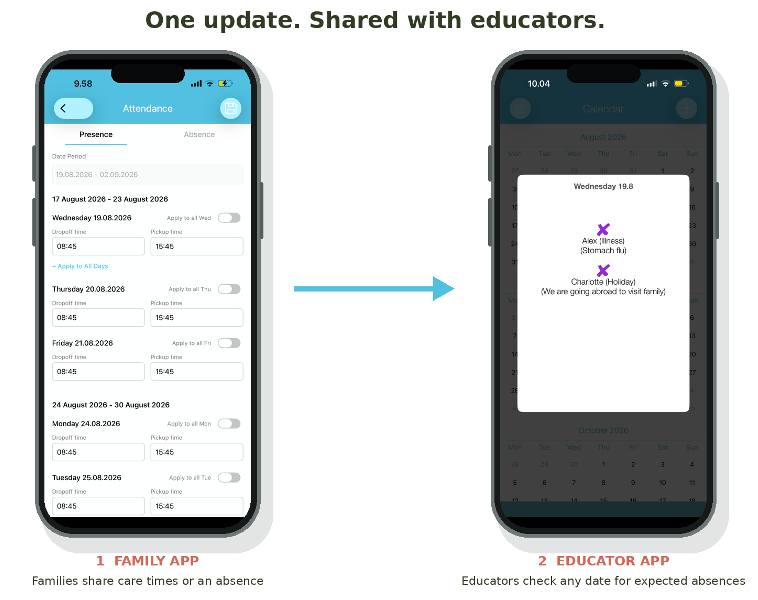
Kindiedays connects attendance information from families to educators to managers in one shared workflow. WATCH VIDEO.
From attendance information to operational decisions
A shared attendance picture can support more reliable workforce forecasts, better-informed substitute planning, more accurate meal quantities, and earlier decisions about rooms, groups, or operating locations. Managers can use exportable reports to examine patterns and support future planning.
More than attendance management
Attendance is one part of the wider Kindiedays platform. The same connected solution also supports pedagogical planning and documentation, learning observations and reports, everyday routine reporting, and communication between educators and families. Centres can manage operational information and each child’s learning journey within one shared digital environment.

See how Kindiedays supports clearer attendance planning
Connect families, educators and managers in one shared flow.