.png)
Finding the right solutions to improve your preschool used to require a lot of work.
You searched Google. Visited dozens of websites. Downloaded brochures. Watched videos. Asked other preschool owners for recommendations. Contacted suppliers. And then tried to understand how very different solutions compared with each other.
Today, searching for information with the help of AI is extremely powerful.
Instead of knowing exactly what product or solution category to search for, you can simply explain your situation.
For example:
"I run an independent private preschool in India with 150 children. We want to move from worksheet-based teaching towards playful and experiential learning. We need a better curriculum, practical lesson plans and teacher training, but we want to keep our own preschool brand. What kinds of solutions should I consider?"
AI can help you understand the alternatives, discover potential providers, compare different approaches and—perhaps most importantly—identify questions you didn't even know you should be asking.
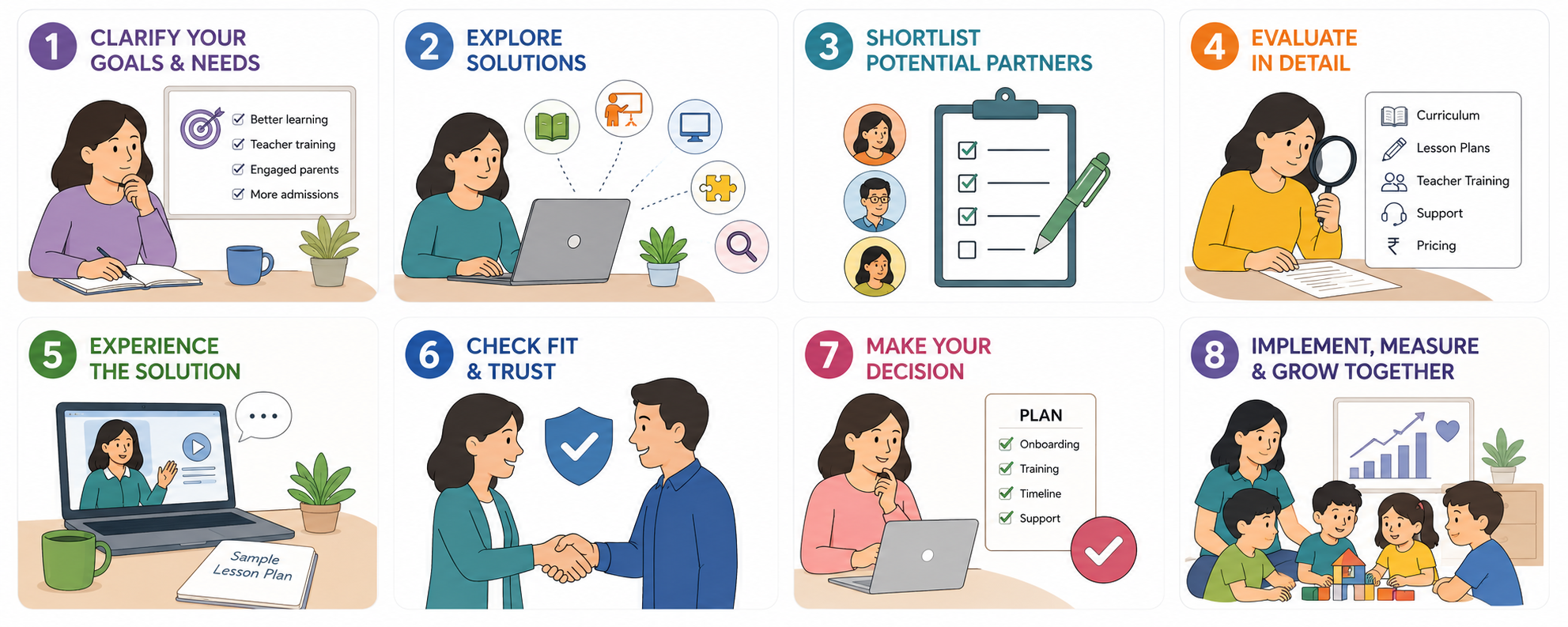
In fact, this entire blog post—including the customer journey, recommendations and enclosed image—has been created with AI.
Consider this blog an example of how you can use AI as a research assistant when making an important decision for your preschool. In Google Search, always select AI Mode.
But don't ask AI simply, "Who is the best provider?"
Use it to help you follow a systematic journey towards a playful learning environment. Here are eight steps to follow.
1. Clarify your goals and needs
Don't start by looking for suppliers. Start with your preschool. What do you actually want to improve?
Perhaps your curriculum is too academic or worksheet-driven. Perhaps teachers struggle to plan meaningful activities. Maybe you want to implement NEP/NCF principles more effectively.
Or perhaps the educational quality is good, but parents don't really understand the value you provide.
Your goals could include:
- introducing more playful and experiential learning
- modernising your curriculum
- improving teacher competence
- reducing teachers' lesson-planning workload
- implementing NEP/NCF principles
- improving observation and assessment
- making children's learning visible to parents
- strengthening parent engagement
- differentiating your preschool
- increasing admissions
Ask AI to help at this stage.
Try:
"I want to transform my preschool towards playful learning. What questions should I ask myself before searching for a solution?"
You might be surprised by the questions it suggests.
2. Explore possible solutions
Now start exploring.
This is where AI search becomes particularly valuable because there isn't necessarily one simple product category called "preschool transformation solution."
Different providers may offer curriculum packages, books, lesson plans, teacher training, preschool software, parent apps, learning materials, or consultancy. And you may need several of them.
Look beyond your local market
When exploring alternatives, don't limit your search only to suppliers in your own country. Consider both local and international providers.
- Local providers can offer important advantages. They understand your national curriculum, language, culture, parent expectations and local preschool market. They may also provide physical learning materials, local training and face-to-face support.
- International providers can bring something different: new pedagogical approaches, international best practices, specialised expertise and educational innovations that may not yet be widely available in your local market.
The best solution may also be a combination of local and international expertise.
For example, you might use locally published books and learning materials while introducing an international play-based curriculum, teacher development programme or digital pedagogical solution.
Don't ask only:
"Which preschool curriculum providers are available in my city?"
Broaden the question:
"What are the best local and international solutions for an independent preschool in India that wants to introduce play-based and experiential learning?"
Then ask AI to explain the advantages and disadvantages of each approach.
Search around your needs rather than around one predefined product.
Ask questions such as:
- "What solutions are available for an independent preschool wanting to introduce play-based learning?"
- What are the best local and international preschool curriculum providers for experiential learning?"
- "Which providers combine preschool curriculum, lesson plans and teacher training?"
- "Which international early education solutions can be implemented in an Indian preschool while adapting to NEP/NCF and the local culture?"
- "What are the alternatives to taking a preschool franchise if I want to improve my existing preschool?"
Then continue asking questions.
AI search becomes more useful as the conversation becomes more specific.
The objective at this stage isn't to find the nearest provider. It is to understand the full range of possibilities and find the approach that best matches the future you want to create for your preschool.
3. Shortlist potential partners
Don't evaluate 20 companies in detail. Create a shortlist of perhaps 2–4 serious alternatives. Look beyond the marketing claims.
Almost every provider today talks about concepts such as "child-centred", "holistic", "play-based", "experiential" and "NEP-aligned".
The important question is:
What do these words mean in everyday classroom practice?
Investigate what each provider actually offers. Does the solution include a structured curriculum? Are there practical lesson plans? How are teachers trained? Are learning materials included? Are digital tools available? How is children's development assessed? How are parents engaged? What implementation support will your preschool receive?
Again, AI can help.
Give it the names of the providers you are considering and ask:
"Compare these providers for an independent preschool that wants to introduce playful learning while keeping its own brand."
You can then tell the AI what matters most to you and ask it to refine the comparison.
4. Evaluate the solutions in detail
Now go deeper. Don't compare providers simply by counting features.
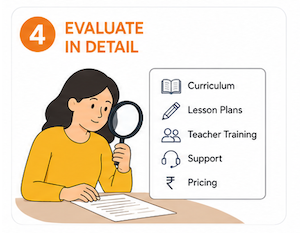
Compare their educational approach.
- Ask to see the curriculum framework and sample lesson plans.
- Take one lesson and imagine one of your teachers using it tomorrow.
- Is it clear?
- Is it practical?
- Does it require materials your teachers can realistically access?
- Is the child actively exploring, experimenting, creating, communicating and thinking?
Or is "activity-based learning" simply another worksheet with a colourful illustration?
Also investigate teacher development. A preschool cannot transform unless its teachers transform with it.
Ask:
"Does the provider merely give teachers materials—or help teachers become better educators?"
And don't forget implementation. The best solution on paper may not be the best solution for your preschool if teachers find it too complicated to use.
5. Experience the solution
This is one of the most important steps. Don't buy a transformation from a brochure.
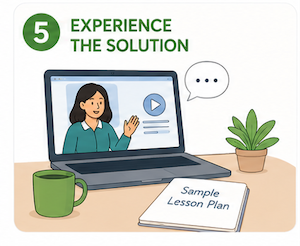
Experience it.
- Attend a demonstration.
- Join a webinar.
- Participate in a sample teacher workshop.
- Ask for sample lesson plans.
- Talk to the provider's education experts.
- If possible, speak with an existing customer.
You might even give a sample lesson plan to one of your teachers and ask:
"Would you be comfortable conducting this activity with your children next week?"
Listen carefully to the answer.
A solution that looks impressive to the preschool owner but feels overwhelming to teachers will be difficult to implement.
6. Check fit and trust
Now move beyond the product. You are choosing a partner.

Preschool transformation takes time. Teachers need support. Questions emerge during implementation. Some practices work immediately; others need adaptation.
Ask yourself:
- Do these people understand our preschool?
- Do they listen to us?
- Can they adapt to our local environment?
- Will they support our teachers after the initial training?
- Do we share a similar view of how young children should learn?
And importantly:
- Do I trust them enough to work with them for several years?
Technology, curriculum and lesson plans matter. But partnership matters too.
7. Make your decision
By now you should have enough information to make an informed decision.
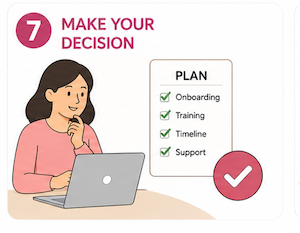
Review the proposal, pricing and contractual terms. But also clarify what happens after you say yes.
- Who will train the teachers?
- How will onboarding work?
- When will implementation begin?
- Who will support your centre head or academic coordinator?
- How will progress be reviewed?
- How will parents be introduced to the new approach?
What does success look like after three months, six months and one year?
The cheapest solution isn't necessarily the most affordable solution. A curriculum nobody uses is expensive at any price. Choose the solution your organisation can realistically implement.
8. Implement, measure and grow together
Signing the agreement isn't the end of the journey. It is the beginning.
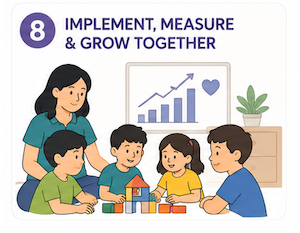
- Train your teachers.
- Introduce new practices step by step.
- Support teachers when they experiment.
- Observe what happens in classrooms.
- Listen to children.
- Collect feedback from parents.
- Review progress with your partner.
And celebrate successes.
Over time, playful learning should stop being something teachers occasionally "do". It should become the way your preschool works.
What should you look for in a great partner?
Every preschool will have different priorities, but we believe six areas deserve particular attention.
- Strong Curriculum — A clear, child-centred curriculum that turns educational objectives into playful and experiential learning.
- Teacher Development — Practical professional development that builds teachers' confidence and competence rather than simply telling them what to do.
- Smart Tools — Tools that make teachers' work easier and support planning, observation, documentation, assessment, and parent communication.
- Implementation Support — Guidance that helps your centre head and teachers turn ideas into everyday practice.
- Proven Results — Evidence that the approach works with real teachers, children, parents and preschools.
- Trust & Partnership — A provider that listens, supports you and wants your preschool to succeed.
Use AI throughout your journey
Don't use AI only to find a list of providers. Use it as a thinking partner throughout the process.
- Ask it to create a requirements checklist.
- Ask it to compare suppliers.
- Upload brochures and ask it to identify important differences.
- Ask it to create questions for supplier meetings.
- Ask it what important questions you may have forgotten.
- Ask it to analyse proposals.
- Ask it to challenge your assumptions.
And finally, ask:
"Based on everything we have discussed, what are the strongest arguments for and against each alternative?"
AI can process enormous amounts of information very quickly.
But you make the decision. You know your children, teachers, parents, business and ambitions better than any AI system does.
Download and share the Customer Journey
We have created the enclosed Customer Journey: Transform Your Preschool poster to summarise these eight steps.
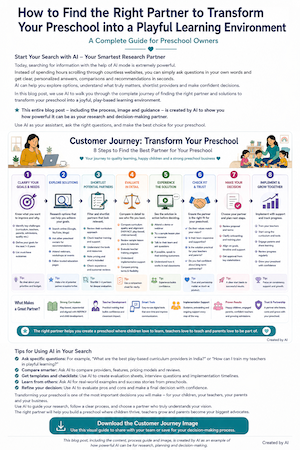
Feel free to download it HERE!
Share it with your centre head or academic coordinator. Discuss it with your management team. Send it to another preschool owner who is considering a similar transformation.
You can even upload the image to your preferred AI assistant and say:
"Help me follow this customer journey. Let's start with Step 1. Ask me questions to clarify the goals and needs of my preschool."
Now AI isn't simply a search engine. It becomes your guide through the journey. And that is also exactly how this blog post was created.
- The text, structure, customer journey, and image were created with the help of AI as a practical demonstration of what is already possible today.
- The technology is available.
- The information is available.
- The educational solutions are available.
The important question is no longer simply: "Where can I find a preschool curriculum?" A much better question is:
"How can I find the right partner to help us create the playful learning environment we want for our children?"
Start there and let AI help you explore the answer. You can easily use Google Search in AI Mode or any other AI tool you prefer.
Want to know what Kindiedays can offer?
You can ask AI, or rather, talk with us.
👉 Learn how Kindiedays can support you with a complete Curriculum Partnership.

I look forward to meeting you.
Milla van der Burgh
👉 Click here to schedule a consultative call on Zoom or contact me on WhatsApp!
PS Join our official WhatsApp group 👉 click here to join the group!