.png)
In many preschools, lesson planning remains one of the biggest hidden pressures on educators.
At the same time, preschool owners and academic leaders are increasingly expected to demonstrate educational quality, intentional teaching, and visible learning outcomes to families.
The new Kindiedays Lesson Library helps preschools bring structure, consistency, and meaningful learning into everyday classroom practice
The Kindiedays Lesson Library was designed to support the full learning process of the Kindiedays Learning System.
Not simply by providing activities, but by helping educators move naturally from planning to teaching, observation, reflection, and assessment within one connected environment.
At the centre of the Lesson Library are ready-to-use, play-based lesson plans inspired by Finnish early childhood education.
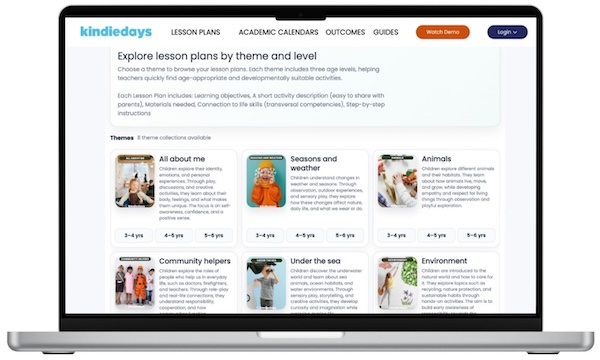
The library includes structured yearly pathways, monthly themes, weekly plans, daily learning experiences, printable materials, and clearly connected learning objectives for children aged 3–6. Rather than asking teachers to build everything from scratch, the system provides a strong pedagogical foundation that educators can confidently build upon and adapt to their own groups.
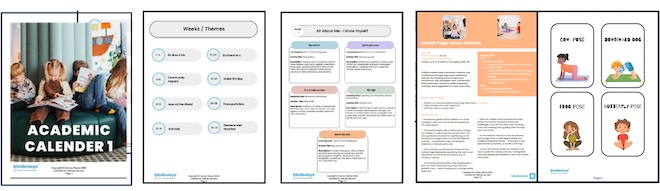
This creates an important balance that many preschools struggle to achieve: consistency without rigidity.
Educators still have the flexibility to follow children’s interests, extend discussions, and personalise activities, while the overall learning journey remains intentional and developmentally appropriate across the centre.
The lesson plans themselves are designed around the principles that make Finnish early childhood education internationally respected. Learning happens through play, exploration, creativity, movement, discussion, and hands-on experiences rather than isolated academic exercises.
A STEM activity may begin with children building bridges together outdoors. A language activity may emerge through storytelling, role play, or shared discussions. Mathematical thinking might develop naturally during cooking, construction play, or problem-solving games.
The goal is not simply to “complete activities,” but to create meaningful learning experiences that support children’s holistic development.
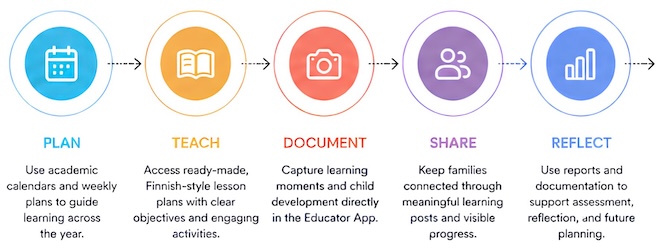
The new Lesson Plan Library links seamlessly to the Kindiedays Learning System
What makes the process particularly powerful is how each stage of learning connects naturally to the next.
In many centres, there is often a disconnect between curriculum objectives and what actually happens in classrooms on a day-to-day basis. Teachers may know the goals, but translating them into engaging, age-appropriate learning experiences takes significant time, creativity, and preparation.
The Kindiedays Lesson Library helps bridge this gap by connecting learning objectives directly to practical classroom experiences. Educators can clearly see the purpose behind each activity while still teaching in a natural, child-centered way.
A practical example
For example, an educator might begin the week by selecting a transportation-themed lesson from the library for a group of 4–5-year-olds. The lesson plan already includes learning objectives, materials, guiding questions, and suggestions for extending children’s thinking through play.
During the activity, children work together to design and build roads using blocks, recycled materials, and loose parts. Some children begin experimenting with bridge structures, while others create stories about where the vehicles are traveling and who lives in the different towns they build.
As the activity develops, the educator can observe collaboration, communication, problem-solving, creativity, early mathematical thinking, and language development happening naturally through play.
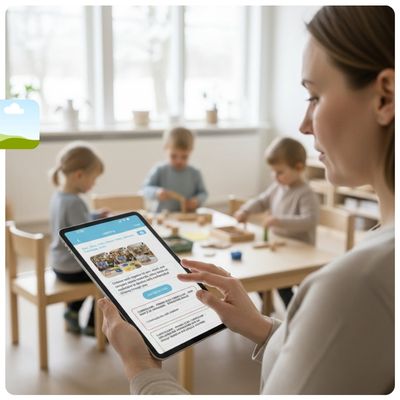
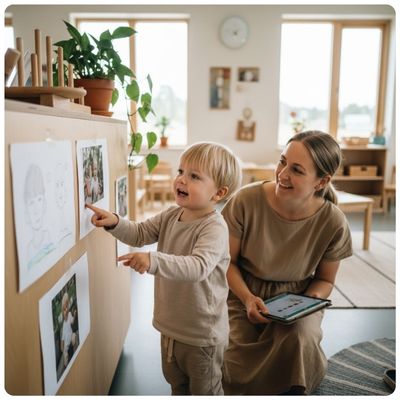
Rather than those observations being forgotten at the end of the day, the educator can quickly document key learning moments in the Kindiedays Educator App using photos, short notes, videos, or learning stories, all linked directly to the activity and learning objectives.
Later, these observations can support reflection, child portfolios, family communication, and assessment discussions without teachers having to manually repeat the work in separate systems.
.jpg)
This is where the process becomes much more than just lesson planning.
The lesson plans create the starting point, but the real strength comes from how planning, teaching, observation, and reflection work together as part of one continuous learning journey.
This also supports smoother teamwork across centres. When educators work from a shared pedagogical structure, it becomes easier to collaborate, maintain quality, support new staff, and ensure children receive consistent learning opportunities across classrooms and age groups.
The heart of the system remains the learning experience itself
The strongest early childhood environments are not built around worksheets, disconnected tools, or rushed planning. They are built around intentional teaching, meaningful play, skilled educators, and systems that give teachers the time and structure to focus on children.
That is the thinking behind the Kindiedays Lesson Library. Not simply a collection of lesson plans, but a building block for the complete Kindiedays Learning System that helps bring high-quality, play-based early childhood education into everyday classroom life.
What next?
👉 Let me show how Kidiedays Learning System strengthens the collaboration between the preschool and parents.

I look forward to meeting you.
Milla van der Burgh
👉 Click here to schedule a consultative call on Zoom or contact me on WhatsApp!