.png)
In Finland, children spend a lot of time outdoors from their earliest years. They play in forests, parks, and playgrounds in all seasons; explore mud and snow; climb over rocks and roots; collect sticks and pinecones; and observe the changing natural world around them.
These experiences are enjoyable for children, but research increasingly suggests that regular contact with nature can also play an important role in children's health, wellbeing, development and learning.
A research-based guide published in 2026 by South-Eastern Finland University of Applied Sciences (Xamk) brings together research on the health and wellbeing benefits of nature during pregnancy and the first years of a child's life. Its message is simple: contact with nature should be part of children's everyday lives.
Nature supports children's developing immune system
One particularly fascinating area of research concerns the relationship between nature and the developing immune system.
The first years of life are an important period for immune development. At the same time, children's microbiota – the communities of microorganisms living on and inside the body – are developing.
Contact with diverse natural environments exposes children to microbes found in soil, plants and other natural materials. According to the research presented in the Xamk guide, this microbial diversity can contribute to the development of the microbiota of the skin, gut and respiratory tract and support the balanced development of the immune system.
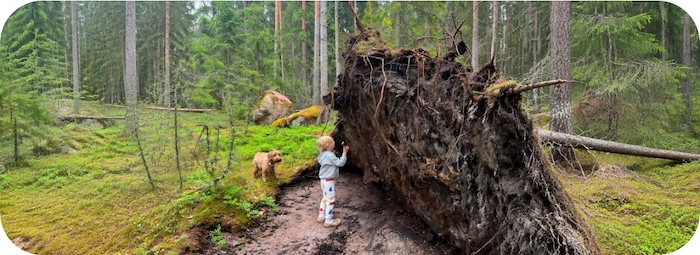
This means that actually interacting with nature matters – touching soil, grass, plants and other natural materials rather than simply looking at nature. For young children, this comes naturally. They want to dig in the soil, pick up stones, examine leaves, crawl on grass and investigate everything they find. Perhaps getting a little dirty is not such a bad thing after all.
Nature supports attention and executive functions
Nature can support the developing brain, too.
Research discussed in the guide connects time in natural environments with children's attention and executive functions, including skills related to concentration and impulse control.
Executive functions are particularly important during childhood. They help children focus their attention, remember instructions, regulate their behaviour, shift between tasks and work towards goals. These abilities provide an important foundation for later learning.
Natural environments can also offer children a break from highly stimulating and adult-directed surroundings. Interestingly, nature can have a calming effect while at the same time increasing alertness – creating favourable conditions for children to concentrate, observe and learn.
For early childhood educators, this is an important reminder: supporting children's ability to learn does not often mean adding more instruction. Sometimes changing the environment can be just as powerful.
Nature develops motor skills through natural movement
Nature encourages children to use their bodies in ways that flat and carefully designed indoor environments cannot easily reproduce.
Uneven ground, rocks, roots, slopes, logs and different surfaces naturally invite children to climb, run, jump, crawl and balance.
According to the research presented in the guide, movement in natural environments supports children's balance, coordination, agility and other motor skills. The beauty is that children rarely experience this as exercise.
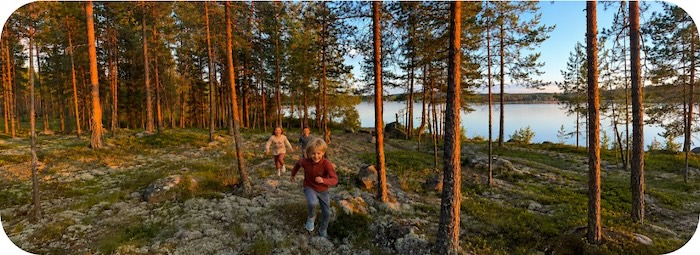
A fallen tree becomes a balance beam. A rock becomes something to climb. A slope invites children to run up and down. A path full of roots requires children to continuously adjust their movements and judge where to place their feet. The environment itself creates new physical challenges – and children respond through play.
Nature supports emotional wellbeing and regulation
Nature can encourage children to be active, but it can also help them slow down.
Research has associated natural environments with positive emotions, psychological wellbeing and recovery from stress. Nature can provide children with space to calm down and may support emotional awareness and regulation.
This is particularly relevant when we consider how stimulating children's everyday lives can be.
Young children spend increasing amounts of time surrounded by screens, noise, traffic, scheduled activities and adult instructions. Natural environments provide a very different experience. There is room to wander, observe, listen and follow one's own interests.
Nature also creates opportunities for children to play together, negotiate, cooperate and practise social skills. Not every moment of childhood needs a predetermined outcome. Sometimes children simply need time and space to explore.
Nature creates powerful opportunities for experiential learning
Nature is not only beneficial for children's health and wellbeing. It is also an exceptionally rich learning environment.
Children learn through their senses and through direct interaction with the world around them. Nature provides endless opportunities to touch, smell, listen, move, compare, investigate, experiment and ask questions.
A group of children might discover a line of ants carrying something across the ground. Soon they are following them.
Where are they going? What are they carrying? Where do ants live? Why are they walking in a line?
The educator doesn't necessarily need to redirect the children towards the planned science activity. The science activity has already begun. This is experiential learning at its most natural.
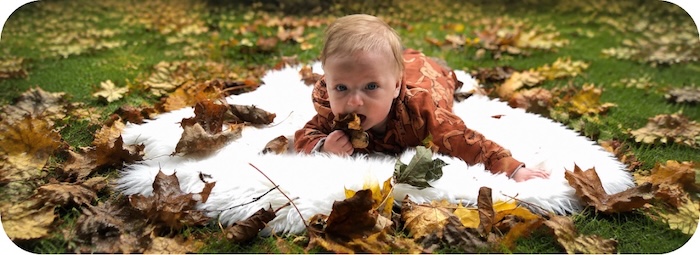
A walk outdoors can involve mathematics when children count pinecones, compare the sizes of stones or discover patterns. It develops language when they describe what they see and learn new words. It becomes science when they investigate insects, plants, weather, water or soil.
At the same time, children move, communicate, solve problems, and use their imagination. One experience can therefore support several areas of learning and development simultaneously, rather than dividing the day into separate subjects.
You don't need a Finnish forest
When we talk about nature-based learning in Finland, it is easy to imagine vast forests and lakes. But one of the most useful messages from the Xamk guide is that meaningful nature experiences don't require spectacular landscapes. For a young child, even a few trees can form a forest.
This makes nature-based learning possible in very different early childhood settings, including preschools in densely populated cities.
A small garden, a nearby park, a patch of grass or a group of trees can provide opportunities for exploration. Children can grow herbs and flowers, care for plants, collect natural materials, investigate insects or experiment with soil, sand and water.
Preschools can also bring more biodiversity into their own environments through planting and natural materials. What matters is not having access to a perfect natural environment. It is giving children regular opportunities to interact with nature using their whole bodies and all their senses.
From outdoor time to outdoor learning
Taking children outside is valuable in itself. But seeing the outdoors as a learning environment opens many more possibilities. It also changes the educator's role.
Instead of organising every minute of outdoor time, educators can observe what attracts children's attention and allow learning to grow from children's discoveries.
A puddle can become an experiment. A collection of stones can lead to sorting, counting and comparing. Building with branches can develop creativity, collaboration and problem-solving. Watching a caterpillar can lead to days of questions and investigation.
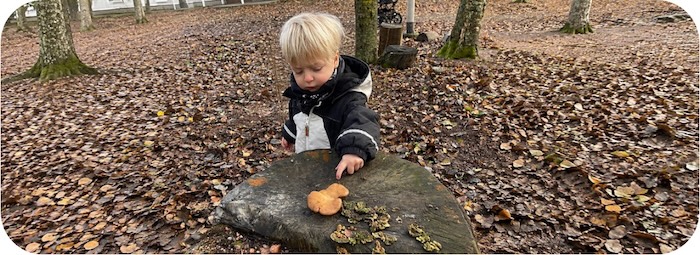
The educator's role is not to provide the activity or the answer. It can be to notice children's interests, ask thoughtful questions, introduce new vocabulary, provide additional materials, and help children take their exploration further.
This is at the heart of play-based and experiential learning.
Let children experience the real world
The research on nature and early childhood provides a powerful reminder of how holistic children's development really is.
The same experience – playing and exploring outdoors – can simultaneously support the developing immune system, executive functions, motor development, emotional wellbeing and learning.
Supporting children's development does not require more technology, more learning materials or more structured instruction. Some of the richest learning environments are already around us.
Nature gives children opportunities to move, touch, observe, imagine, investigate, communicate, solve problems and play. And research increasingly suggests that regular contact with nature can support their health and wellbeing at the same time.
Perhaps one of the most valuable things we can do is simply create more opportunities for children to experience nature – wherever they are.
This article is based on research presented in the 2026 guide Luonnon kasvattamat – opas luonnon terveyshyödyistä odotus- ja pikkulapsiaikaan, by Sanna Kuosmanen and Reetta Korhonen, South-Eastern Finland University of Applied Sciences (Xamk).
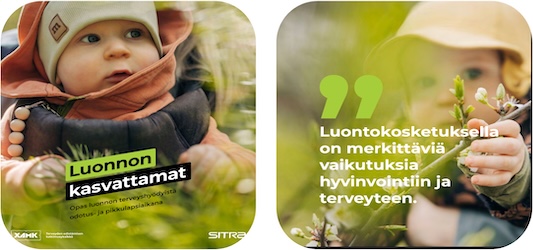
"Contact with nature has significant effects on well-being and health"
Read the original Xamk guide (in Finnish)