.png)
Walk into most early years centres after closing time, and you’ll notice something telling: the day isn’t really over.
Teachers are still planning tomorrow’s activities. Documentation is being completed retrospectively. Leaders are balancing inspection requirements while responding to increasingly detailed parent questions. The energy and commitment are undeniable—but so is the strain. No time to plan for transformation to new play-based education.

For school owners, the need for renewal has implications far beyond the classroom.
You are not only responsible for pedagogy, but for the long-term sustainability of your centre. This includes:
- Retaining skilled educators in a competitive market
- Building trust and transparency with parents
- Maintaining strong enrolment and occupancy
- Demonstrating quality during inspections
- Protecting and strengthening your reputation
- Ensuring financial stability over time
A Shift Toward Intentional Systems
Increasingly, school owners are recognising that sustainable quality in early years education does not come from working harder in an academic system, but from working within a well-designed play-based education system.

At the heart of this approach is a principle long associated with Finnish early childhood education: children learn best through play—but that play must be intentionally guided by skilled professionals. This distinction matters. When supported by clear objectives and thoughtful planning, play becomes a powerful vehicle for development. Without structure, however, it risks becoming difficult to document, assess, or communicate.
This shift is not about adding more tools or layers of complexity. It is about organising what already exists into a structure that supports consistency, clarity, and professional confidence in play-based learning.
Making Learning Visible and Defensible
One of the defining challenges for early years leaders today is not only delivering high-quality learning experiences, but making those experiences visible to others. Parents want to understand how their child is developing. Inspectors expect alignment with national frameworks. Educators need clarity on goals and progression. This requires more than good teaching—it requires coherence.
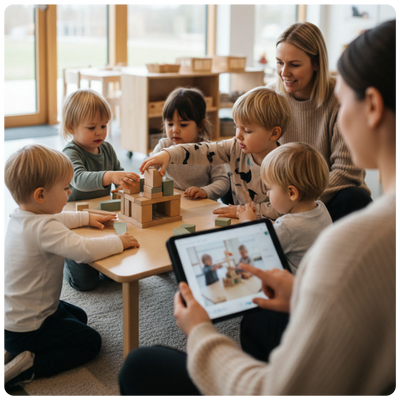
Imagine a setting where planning, observation, and documentation are connected from the outset. Where evidence of learning is captured as part of daily practice, rather than added retrospectively. Where educators can clearly articulate not just what children are doing, but why it matters for their development.
In such an environment, quality becomes both visible and defensible.
What makes your centre meaningfully different?
The answer is no longer found in surface-level claims or borrowed labels. It lies in the ability to demonstrate a structured, intentional approach to learning—one that aligns with recognised educational principles while remaining practical in daily use.
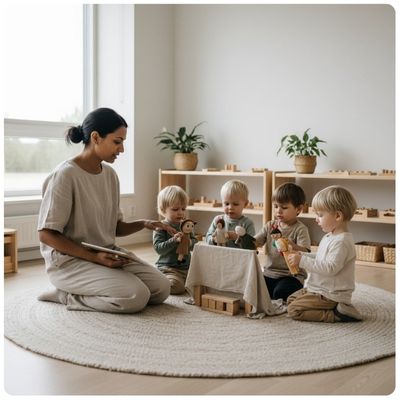
The question is no longer whether play-based learning is effective. The evidence for that is well established.
The more pressing question for school owners is this:
Do you have a system strong enough to make that learning visible, measurable, and consistently delivered—without over-relying on individual effort?
Platforms such as Kindiedays have emerged in response to this need, not as additional layers of work, but as systems designed to align pedagogy, planning, and documentation. The value is not in the technology itself, but in the operational clarity it enables.
Kindiedays provides preschools with a comprehensive curriculum, combining Finnish play-based pedagogy with local requirements. We offer structured, theme-based lesson plans, teacher training, digital tools for pedagogical documentation (portfolios), and real-time parent engagement apps to improve learning quality, enhance teacher competence, and boost enrolment.
What next?
👉 Learn more about how Kindiedays can support your preschool with a complete Curriculum Partnership — combining Finnish early education principles, digital tools, lesson plans, and teacher workshops tailored for challenger preschools.

👉 Click here to schedule a consultative call on Zoom or contact me on WhatsApp!
I look forward to meeting you.
Milla van der Burgh