.png)
A preschool learning environment is much more than colourful walls and toys. The entire ecosystem supports children’s holistic development through routines, interactions, materials, activities, and relationships. The most successful preschools intentionally design environments where children feel safe, curious, engaged, and supported.
A high-quality environment does not depend on expensive infrastructure. It depends on thoughtful planning and a clear understanding of how young children learn. This guide explores 8 topics that help preschool owners and teachers build a vibrant, structured, and developmentally appropriate learning environment. You can also join Kindiedays Academy online for interactive workshops where we explore these cornerstones. The next cohort starts on December 20th. Check Kindiedys Academy HERE.
1. A Child-Centred Philosophy
Every strong preschool begins with a child-centred approach—one that views children as active learners rather than passive receivers of information. This means:
- Activities encourage exploration
- Teachers guide instead of constantly instructing
- Children make choices within structured routines
- Learning happens through play, conversation, movement, and discovery
A child-centred philosophy creates confident, joyful learners who are genuinely ready for primary school.

2. Thoughtfully Designed Learning Spaces
The classroom should be divided into learning corners that reflect different developmental areas:
- Reading Corner – books, story props, puppets
- Pretend Play Corner – kitchen sets, dress-up, role-play materials
- Art Corner – crayons, paper, natural materials
- Math & Logic Corner – sorting items, blocks, puzzles
- Science Corner – plants, sensory trays, magnets
- Gross Motor Area – balancing lines, tunnels, soft blocks
The goal is not to fill the classroom with materials but to create purposeful spaces that invite meaningful play.

3. Consistent Routines that Support Emotional Security
Children thrive on predictability. A well-structured day helps them feel secure and ready to participate. A daily schedule should include:
- Welcome time
- Circle time
- Free play in learning corners
- Teacher-led activities
- Outdoor play
- Snack and rest time
- Story time
- Closing routine
Routines must be flexible enough to accommodate children’s needs while maintaining order.

4. Playful and Purposeful Activities
A high-quality environment uses play as the foundation for learning. Activities should:
- Promote curiosity
- Encourage problem-solving
- Build language skills
- Develop fine and gross motor abilities
- Strengthen social skills
- Introduce early numeracy and literacy in age-appropriate ways
Play-based learning does not mean “free play all day.” Instead, teachers plan meaningful experiences in which learning goals are embedded in engaging activities.

5. Supportive Relationships Between Teachers and Children
Warm, responsive interactions are the most critical component of a good preschool. Teachers should:
- Greet each child personally
- Listen attentively
- Encourage conversations
- Guide behaviour with kindness
- Help children express feelings
- Observe and respond to individual needs
Children learn best when they feel emotionally supported.

6. Observation and Documentation of Learning
Modern preschools emphasize continuous observation rather than formal testing. Teachers record:
- Milestones
- New skills
- Social behaviours
- Interests
- Learning progress
Documentation can include photos, videos, notes, and children’s work. When shared with parents through portfolios or digital tools, it strengthens trust and gives parents clear insight into their child’s growth.

7. Strong Partnerships with Parents
Parents are key partners in the learning journey. High-quality preschools:
- Share regular updates
- Send activity photos
- Communicate learning goals
- Offer parenting guidance
- Encourage home-based activities
- Listen to parent feedback
When parents understand how and what their children are learning, they become strong advocates for the school.

8. Well-Trained and Confident Teachers
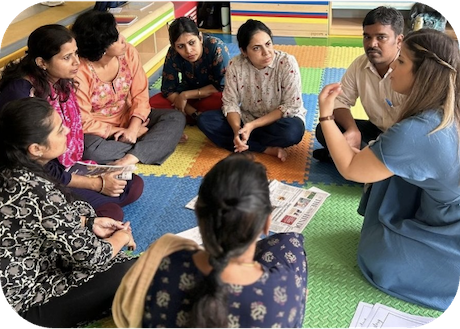
An environment is only as strong as the teachers who guide it. Ongoing professional development ensures teachers:
- Understand child development
- Use play-based methods effectively
- Facilitate learning in mixed-ability classrooms
- Manage behaviour positively
- Communicate clearly with parents
Workshops and training programs help teachers grow and stay motivated.
Final Thoughts
A high-quality preschool environment is a careful blend of thoughtful spaces, meaningful play, strong relationships, structured routines, and responsive teaching. By focusing on holistic development and research-based practices, preschools can create learning spaces where children feel valued, engaged, and eager to learn. When built with intention, such environments become a key differentiator for your preschool and a source of pride for families who trust you with their children.
What next?
👉 Learn more about how Kindiedays can support your preschool with a complete Curriculum Partnership — combining Finnish early education principles, digital tools, lesson plans, and teacher workshops tailored for challenger preschools.

I look forward to meeting you.
Milla van der Burgh
👉 Click here to schedule a consultative call on Zoom or contact me on WhatsApp!
Said by our customers
"We blend play-based learning with foundational academics, fostering curiosity, creativity, and critical thinking. This ensures a nurturing environment where students develop essential social, emotional, and cognitive skills while laying a foundation for lifelong learning.” Jitendra Dewoolkar, Founder Trustee, Cresmonde World School, India